10. an earthquake recorded by seismic stations around the world created the pattern of seismic - wave…
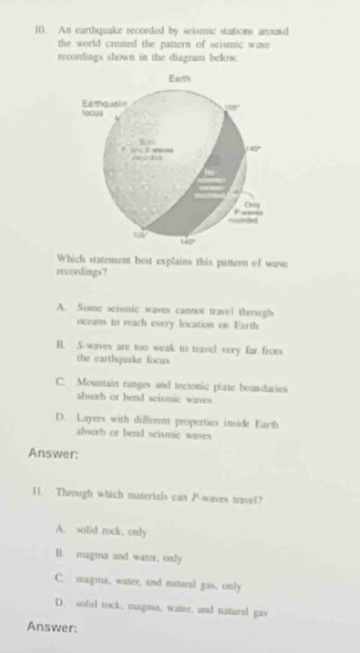
10. an earthquake recorded by seismic stations around the world created the pattern of seismic - wave recordings shown in the diagram below.\nwhich statement best explains this pattern of wave recordings?\na. some seismic waves cannot travel through oceans to reach every location on earth.\nb. s - waves are too weak to travel very far from the earthquake focus.\nc. mountain ranges and tectonic plate boundaries absorb or bend seismic waves.\nd. layers with different properties inside earth absorb or bend seismic waves.\nanswer:\n11. through which materials can p - waves travel?\na. solid rock, only\nb. magma and water, only\nc. magma, water, and natural gas, only\nd. solid rock, magma, water, and natural gas\nanswer:
Answer
Brief Explanations:
For question 10, seismic wave patterns are affected by Earth's internal layers with different properties that can absorb or bend waves. For question 11, P - waves can travel through solid rock, magma, water, and natural gas as they are compressional waves that can move through various states of matter.
Answer:
- D. Layers with different properties inside Earth absorb or bend seismic waves
- D. solid rock, magma, water, and natural gas