12 jody learns that water moving over the falls formed the cave. which choice best explains how the cave…
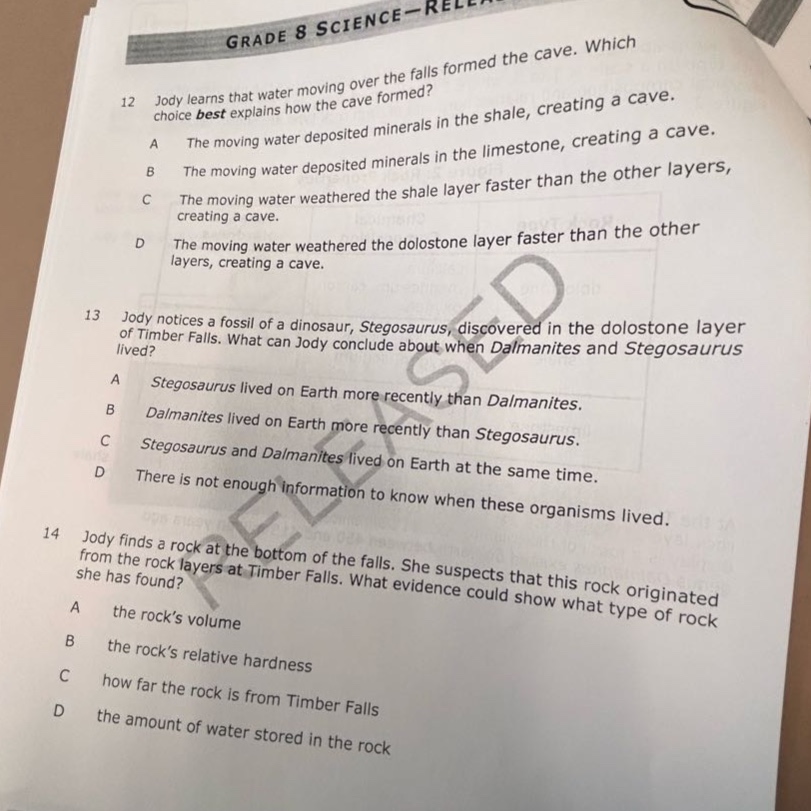
12 jody learns that water moving over the falls formed the cave. which choice best explains how the cave formed?\na the moving water deposited minerals in the shale, creating a cave.\nb the moving water deposited minerals in the limestone, creating a cave.\nc the moving water weathered the shale layer faster than the other layers, creating a cave.\nd the moving water weathered the dolostone layer faster than the other layers, creating a cave.\n13 jody notices a fossil of a dinosaur, stegosaurus, discovered in the dolostone layer of timber falls. what can jody conclude about when dalmanites and stegosaurus lived?\na stegosaurus lived on earth more recently than dalmanites.\nb dalmanites lived on earth more recently than stegosaurus.\nc stegosaurus and dalmanites lived on earth at the same time.\nd there is not enough information to know when these organisms lived.\n14 jody finds a rock at the bottom of the falls. she suspects that this rock originated from the rock layers at timber falls. what evidence could show what type of rock she has found?\na the rocks volume\nb the rocks relative hardness\nc how far the rock is from timber falls\nd the amount of water stored in the rock
Answer
12.
Brief Explanations:
Weathering is the breakdown of rocks. Shale is more easily weathered by moving water compared to some other rocks. This can create caves.
Answer:
C. The moving water weathered the shale layer faster than the other layers, creating a cave.
13.
Brief Explanations:
In general, fossils found in lower rock layers are older. Dinosaur fossils like Stegosaurus are from the Mesozoic era, while Dalmantes are older fossils. So Stegosaurus lived more recently.
Answer:
A. Stegosaurus lived on Earth more recently than Dalmantes.
14.
Brief Explanations:
The relative hardness of a rock can be an important characteristic to identify its type. Different rock - types have different hardness levels.
Answer:
B. the rock’s relative hardness