14. rocks and fossils are dated in several ways. relative dating uses the order of rock strata to determine…
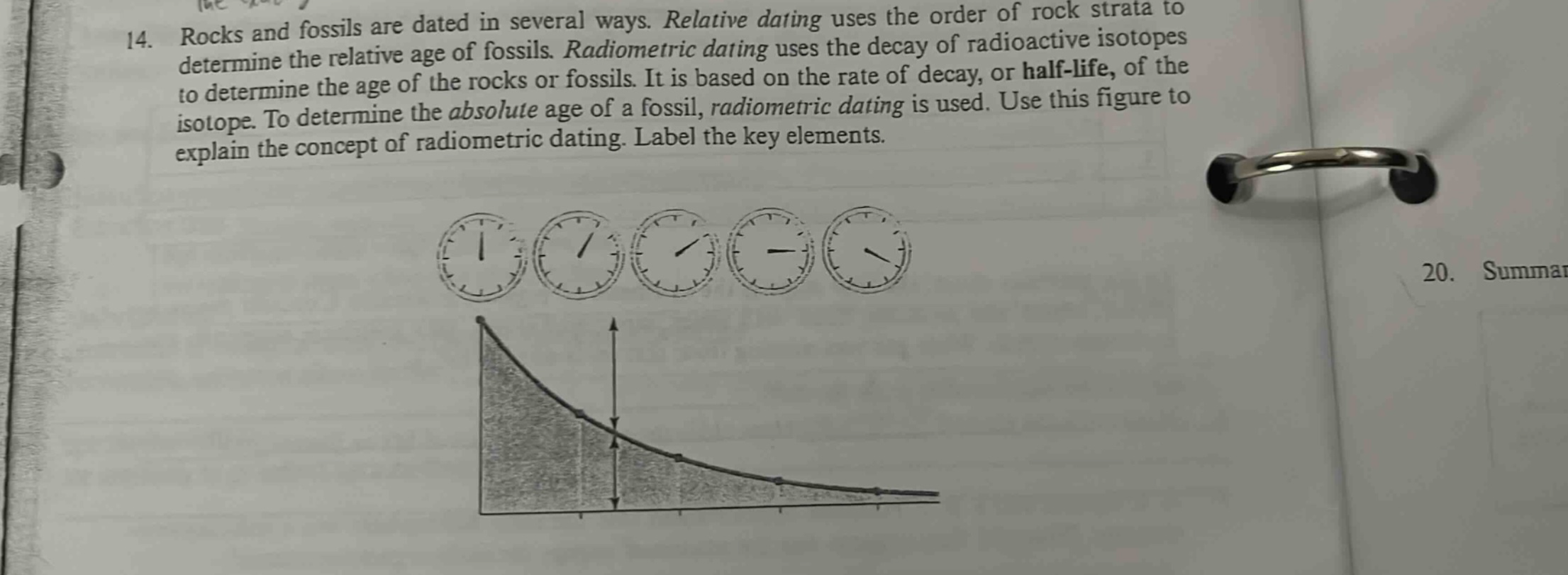
14. rocks and fossils are dated in several ways. relative dating uses the order of rock strata to determine the relative age of fossils. radiometric dating uses the decay of radioactive isotopes to determine the age of the rocks or fossils. it is based on the rate of decay, or half - life, of the isotope. to determine the absolute age of a fossil, radiometric dating is used. use this figure to explain the concept of radiometric dating. label the key elements.
Answer
Brief Explanations:
Radiometric dating uses the decay of radioactive isotopes. The key elements are the radioactive isotope, its half - life (the time it takes for half of the isotope to decay), the initial amount of the isotope in the rock or fossil, and the current amount of the isotope. The clocks in the figure may represent the passage of time in terms of half - lives, and the curve shows the decrease in the amount of the radioactive isotope over time. By measuring the ratio of the parent (original) isotope to the daughter (decay product) isotope and knowing the half - life, the age of the rock or fossil can be calculated.
Answer:
The key elements are radioactive isotope, half - life, initial amount of isotope, current amount of isotope. Radiometric dating is based on the decay of radioactive isotopes where the age of a rock or fossil is determined by measuring the ratio of parent to daughter isotopes and using the known half - life of the isotope.