15. a 600 year old rock contains 25% parent isotope. one half life is _ years.\n19. a 3000 year old rock…
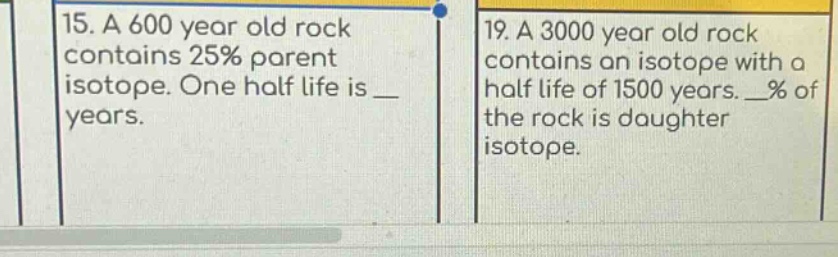
15. a 600 year old rock contains 25% parent isotope. one half life is _ years.\n19. a 3000 year old rock contains an isotope with a half life of 1500 years. _% of the rock is daughter isotope.
Answer
Explanation:
Step1: Determine number of half - lives for the first rock
The formula for radioactive decay is $N = N_0(\frac{1}{2})^n$, where $N$ is the amount of parent isotope remaining, $N_0$ is the initial amount of parent isotope, and $n$ is the number of half - lives. Given $N = 0.25N_0$, we can solve for $n$: $0.25N_0=N_0(\frac{1}{2})^n$. Divide both sides by $N_0$ (since $N_0\neq0$), we get $0.25 = (\frac{1}{2})^n$. Since $0.25=\frac{1}{4}=(\frac{1}{2})^2$, $n = 2$. The rock is 600 years old and has gone through 2 half - lives. So the half - life $t_{1/2}=\frac{600}{2}=300$ years.
Step2: Determine number of half - lives for the second rock
The rock is 3000 years old and the half - life $t_{1/2}=1500$ years. The number of half - lives $n=\frac{3000}{1500}=2$. Using the formula $N = N_0(\frac{1}{2})^n$, with $n = 2$, the fraction of parent isotope remaining is $(\frac{1}{2})^2=\frac{1}{4}=0.25$ or 25%. The fraction of daughter isotope is $1 - 0.25 = 0.75$ or 75%.
Answer:
- 300
- 75%