15. describe the following identifying test of:\na. streak-\nb. luster-\nc. cleavage-\n16. explain how…
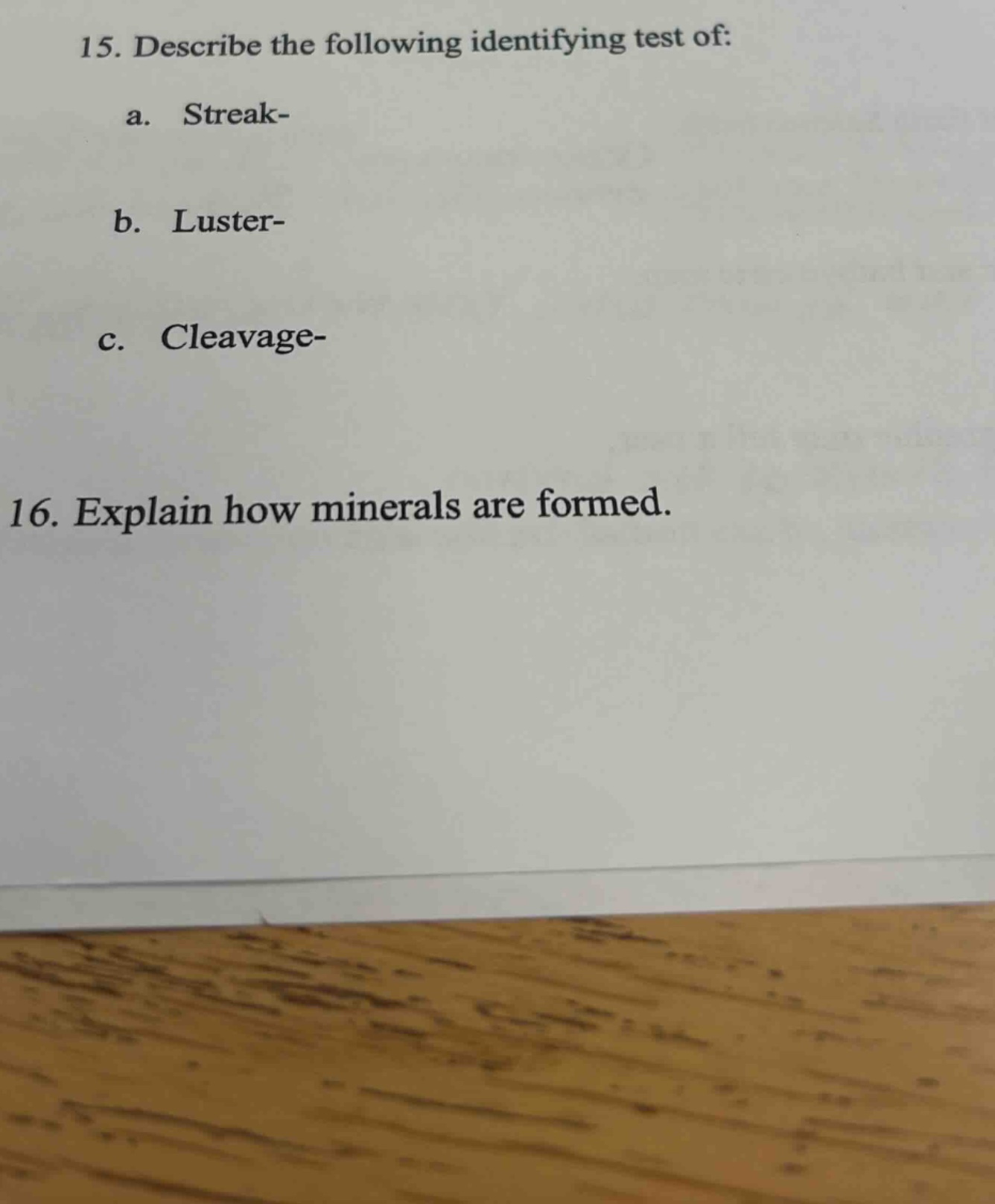
15. describe the following identifying test of:\na. streak-\nb. luster-\nc. cleavage-\n16. explain how minerals are formed.
Answer
Brief Explanations:
a. Streak is the color of a mineral in powdered form, obtained by scratching it on a streak - plate. It helps in mineral identification as the streak color is often more consistent than the surface color of the mineral. b. Luster describes the way a mineral reflects light. It can be metallic (shiny like metal), non - metallic (such as vitreous like glass, pearly, or earthy). c. Cleavage is the tendency of a mineral to break along smooth, flat planes. It is related to the internal crystal structure of the mineral. Minerals can have one, two, three, or more directions of cleavage. Minerals are formed through various processes. Magmatic processes occur when molten rock (magma or lava) cools and solidifies, with different minerals crystallizing at different temperatures. Sedimentary processes involve the precipitation of minerals from water solutions, often in layers. Metamorphic processes occur when existing minerals are subjected to high pressure, high temperature, or chemically active fluids, causing them to recrystallize or react to form new minerals.
Answer:
a. The color of a mineral in powdered form, obtained by scratching on a streak - plate for identification. b. The way a mineral reflects light, can be metallic or non - metallic. c. The tendency of a mineral to break along smooth, flat planes related to its crystal structure. Minerals are formed through magmatic (cooling of molten rock), sedimentary (precipitation from water), and metamorphic (high pressure/temperature/chemical fluids) processes.