5 - 15. determine the reactions at the supports.
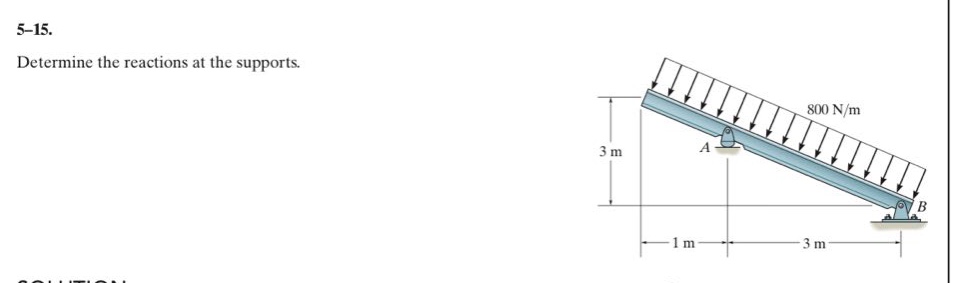
5 - 15. determine the reactions at the supports.
Answer
Explanation:
Step1: Calculate total load
The uniformly - distributed load (w = 800\ N/m) and the length of the loaded part (L=3\ m). The total load (P) due to the uniformly - distributed load is (P = wL). So (P=800\times3 = 2400\ N), and this load acts at the centroid of the distributed - load region, which is (x=\frac{3}{2}=1.5\ m) from point (A) along the length of the loaded part.
Step2: Take moment about point (A)
Let the reaction at (B) be (R_B). The moment equilibrium equation (\sum M_A=0). The total load creates a clock - wise moment and the reaction (R_B) creates a counter - clockwise moment. The vertical distance from (A) to (B) is (y = 3\ m). The moment due to the load about (A) is (M_{load}=2400\times(1 + 1.5)) (the distance from (A) to the centroid of the load). The moment due to (R_B) about (A) is (M_{R_B}=R_B\times4). So (\sum M_A=2400\times(1 + 1.5)-R_B\times4 = 0). Solving for (R_B): [ \begin{align*} 2400\times2.5&=R_B\times4\ R_B&=\frac{2400\times2.5}{4}\ R_B& = 1500\ N \end{align*} ]
Step3: Calculate reaction at (A)
For vertical force equilibrium (\sum F_y = 0). Let the reaction at (A) be (R_A). We have (R_A+R_B - 2400=0). Substitute (R_B = 1500\ N) into the equation: (R_A=2400 - 1500=900\ N)
Answer:
The reaction at support (A) is (R_A = 900\ N) and the reaction at support (B) is (R_B=1500\ N)