23. compare the forces that determine the distribution of goods and services.\nfree enterprise economy…
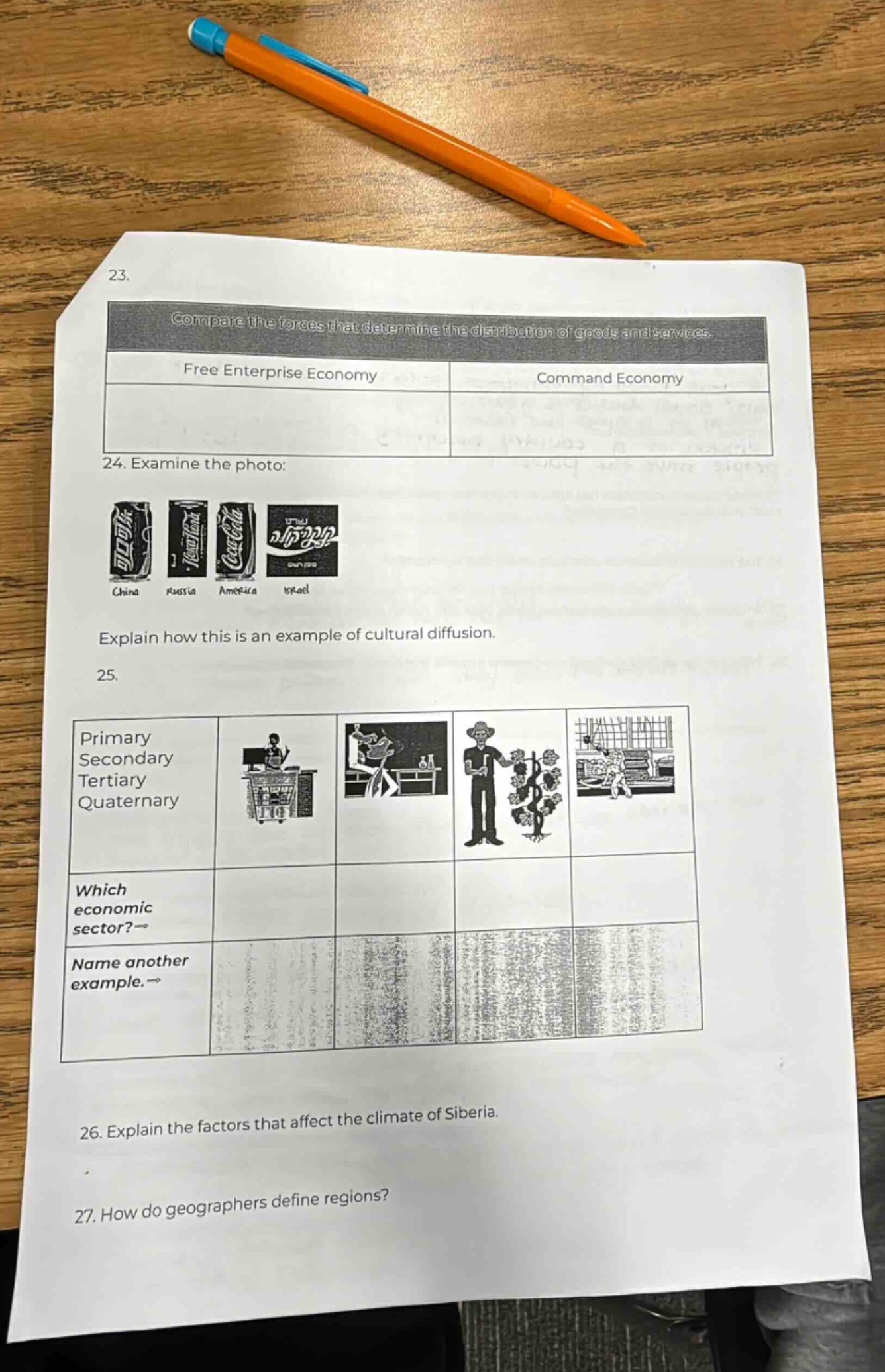
23. compare the forces that determine the distribution of goods and services.\nfree enterprise economy command economy\n24. examine the photo:\nchina russia america israel\nexplain how this is an example of cultural diffusion.\n25.\nprimary secondary tertiary quaternary\nwhich economic sector?→\nname another example.→\n26. explain the factors that affect the climate of siberia.\n27. how do geographers define regions?
Answer
Brief Explanations:
Question 23:
In a free - enterprise economy, market forces like supply and demand, competition, and consumer choice determine the distribution of goods and services. In a command economy, the government makes decisions about production, distribution, and pricing.
Question 24:
Coca - Cola is an American product. Its presence in China, Russia, and Israel shows how a cultural product (a brand of soft - drink) spreads from its origin country to other countries, which is an example of cultural diffusion.
Question 25:
The first image (person at a cash - register) is a tertiary sector activity (service sector). Another example is a bank teller. The second image (person in a factory) is a secondary sector activity (manufacturing). Another example is a car - factory worker. The third image (person farming) is a primary sector activity (extracting natural resources). Another example is a miner. The fourth image (person in an office doing intellectual work) is a quaternary sector activity (knowledge - based services). Another example is a software developer.
Question 26:
Factors affecting Siberia's climate include its high latitude (receives less direct sunlight), large landmass (continental climate with extreme temperature variations), and the presence of mountain ranges that can block or redirect air masses.
Question 27:
Geographers define regions based on physical characteristics (like landforms, climate), cultural characteristics (language, religion, customs), economic activities, or political boundaries.
Answer:
Question 23:
In a free - enterprise economy, market forces such as supply, demand, and competition determine the distribution of goods and services. Consumers' purchasing decisions and producers' profit - seeking behavior play key roles. In a command economy, the government plans and controls the distribution, deciding what to produce, how much, and for whom.
Question 24:
Coca - Cola is an American brand. Its availability in China, Russia, and Israel demonstrates cultural diffusion as a cultural product (a popular soft - drink brand) has spread beyond its country of origin to different cultural contexts around the world.
Question 25:
- First image: Tertiary sector. Another example: A hotel receptionist.
- Second image: Secondary sector. Another example: A furniture - maker.
- Third image: Primary sector. Another example: A fisherman.
- Fourth image: Quaternary sector. Another example: A research scientist.
Question 26:
Siberia's high latitude means it gets less direct sunlight, leading to cold temperatures. Its large landmass contributes to a continental climate with wide temperature ranges between summer and winter. Mountain ranges can influence air circulation and precipitation patterns.
Question 27:
Regions can be defined by physical features like deserts or mountains, cultural elements like shared languages or religions, economic activities such as agriculture - based or industrial regions, or political divisions like countries or states.