60. cicadas are insects that spend most of their lives developing underground, then emerge after a period of…
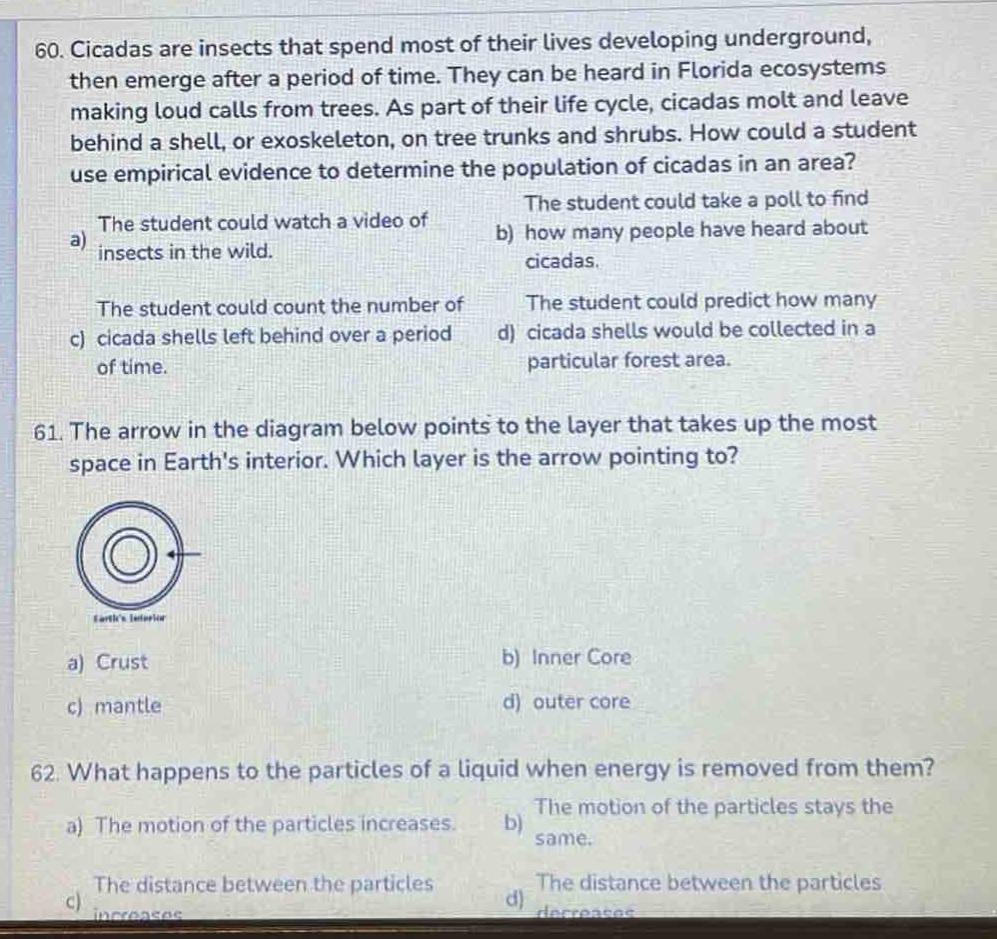
60. cicadas are insects that spend most of their lives developing underground, then emerge after a period of time. they can be heard in florida ecosystems making loud calls from trees. as part of their life - cycle, cicadas molt and leave behind a shell, or exoskeleton, on tree trunks and shrubs. how could a student use empirical evidence to determine the population of cicadas in an area?\na) the student could watch a video of insects in the wild.\nthe student could count the number of cicada shells left behind over a period of time.\nb) the student could take a poll to find how many people have heard about cicadas.\nthe student could predict how many cicada shells would be collected in a particular forest area.\n61. the arrow in the diagram below points to the layer that takes up the most space in earths interior. which layer is the arrow pointing to?\na) crust\nb) inner core\nc) mantle\nd) outer core\n62. what happens to the particles of a liquid when energy is removed from them?\na) the motion of the particles increases.\nb) the motion of the particles stays the same.\nc) the distance between the particles increases.\nd) the distance between the particles decreases.
Answer
Brief Explanations:
- For question 60, empirical evidence involves direct observation and measurement. Counting cicada - shells over time is a direct way to estimate the cicada population as each shell represents a cicada that has molted. Watching a video, taking a poll, or making a prediction are not empirical methods for determining the population.
- For question 61, the mantle is the layer of Earth's interior that takes up the most space. The crust is the thin outer layer, the inner core and outer core are smaller in volume compared to the mantle.
- For question 62, when energy is removed from a liquid, the kinetic energy of its particles decreases. This causes the particles to move more slowly and the distance between them to decrease as they come closer together.
Answer:
- c) The student could count the number of cicada shells left behind over a period of time.
- c) mantle
- d) The distance between the particles decreases.