9. more than 60% of journeys in mexico city occur via public transit, but simply reproducing a feature of…
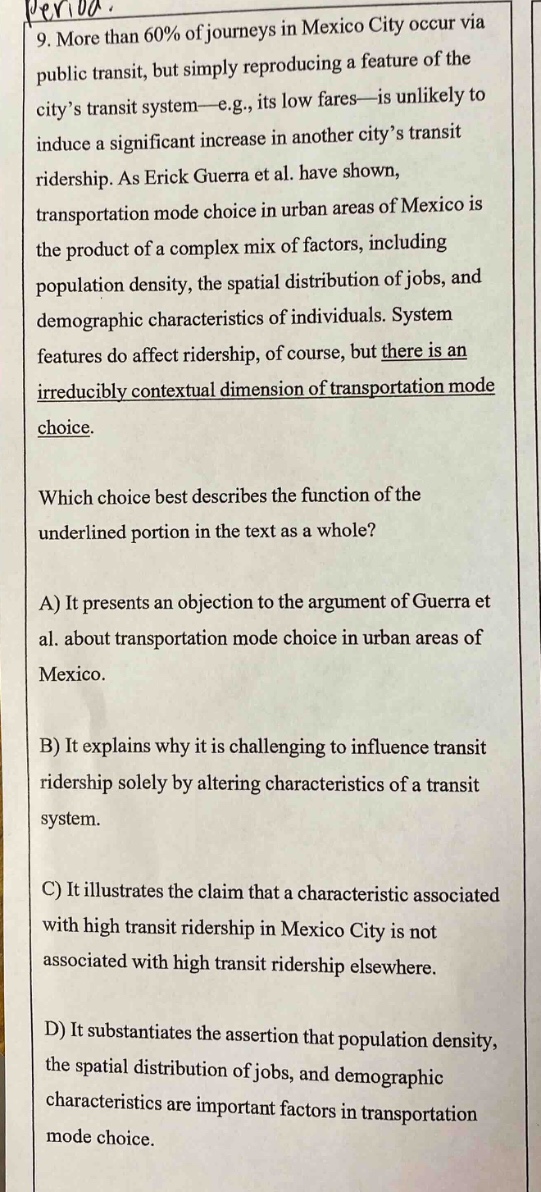
9. more than 60% of journeys in mexico city occur via public transit, but simply reproducing a feature of the city’s transit system—e.g., its low fares—is unlikely to induce a significant increase in another city’s transit ridership. as erick guerra et al. have shown, transportation mode choice in urban areas of mexico is the product of a complex mix of factors, including population density, the spatial distribution of jobs, and demographic characteristics of individuals. system features do affect ridership, of course, but there is an irreducibly contextual dimension of transportation mode choice. which choice best describes the function of the underlined portion in the text as a whole? a) it presents an objection to the argument of guerra et al. about transportation mode choice in urban areas of mexico. b) it explains why it is challenging to influence transit ridership solely by altering characteristics of a transit system. c) it illustrates the claim that a characteristic associated with high transit ridership in mexico city is not associated with high transit ridership elsewhere. d) it substantiates the assertion that population density, the spatial distribution of jobs, and demographic characteristics are important factors in transportation mode choice.
Answer
Brief Explanations:
The text first states that simply copying a transit - system feature won't significantly increase ridership in another city. Then it mentions that transportation mode choice is complex. The underlined part emphasizes the contextual nature of transportation mode choice, which explains why changing transit - system characteristics alone is challenging for influencing ridership.
Answer:
B. It explains why it is challenging to influence transit ridership solely by altering characteristics of a transit system.