90) a volcano that is fairly symmetrical and has both layers of lava and pyroclastic deposits is a\n a)…
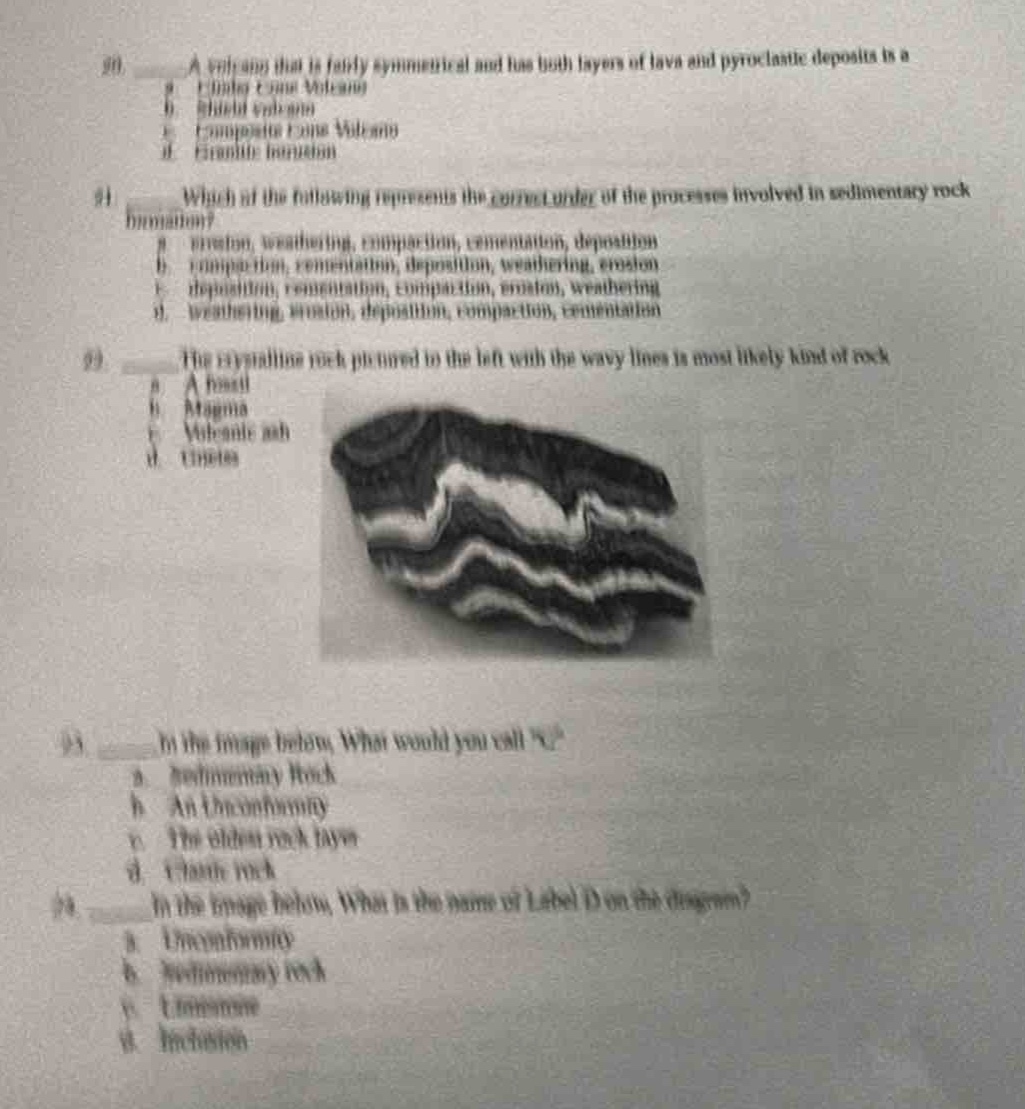
90) a volcano that is fairly symmetrical and has both layers of lava and pyroclastic deposits is a\n a) shield volcano\n b) cinder - cone volcano\n c) composite (stratovolcano)\n d) fissure eruption\n91) which of the following represents the correct order of the processes involved in sedimentary rock formation?\n a) erosion, weathering, compaction, cementation, deposition\n b) compaction, cementation, deposition, weathering, erosion\n c) deposition, cementation, compaction, erosion, weathering\n d) weathering, erosion, deposition, compaction, cementation\n92) the crystalline rock pictured to the left with the wavy lines is most likely kind of rock\n a) a basalt\n b) magma\n c) volcanic ash\n d) gneiss\n93) in the image below, what would you call \x\?\n a) sedimentary rock\n b) an unconformity\n c) the oldest rock layer\n d) igneous rock\n94) in the image below, what is the name of label d on the diagram?\n a) unconformity\n b) sedimentary rock\n c) limestone\n d) intrusion
Answer
Answer:
- c. Composite cone Volcano
- d. weathering, erosion, deposition, compaction, cementation
- d. marble (assuming the wavy - lined rock is a metamorphic rock like marble)
- No image provided for this question, unable to answer.
- No image provided for this question, unable to answer.
Brief Explanations:
- Composite cone volcanoes are fairly symmetrical and have layers of lava and pyroclastic deposits.
- The correct sequence for sedimentary rock formation starts with weathering of pre - existing rocks, followed by erosion, then deposition of the eroded material, compaction of the deposited particles, and finally cementation.
- Marble is a metamorphic rock that can have wavy or banded patterns. Since no image is provided for questions 4 and 5, no explanations can be given for them.