according to the federal trade commission report on consumer fraud and identity theft, 23% of all complaints…
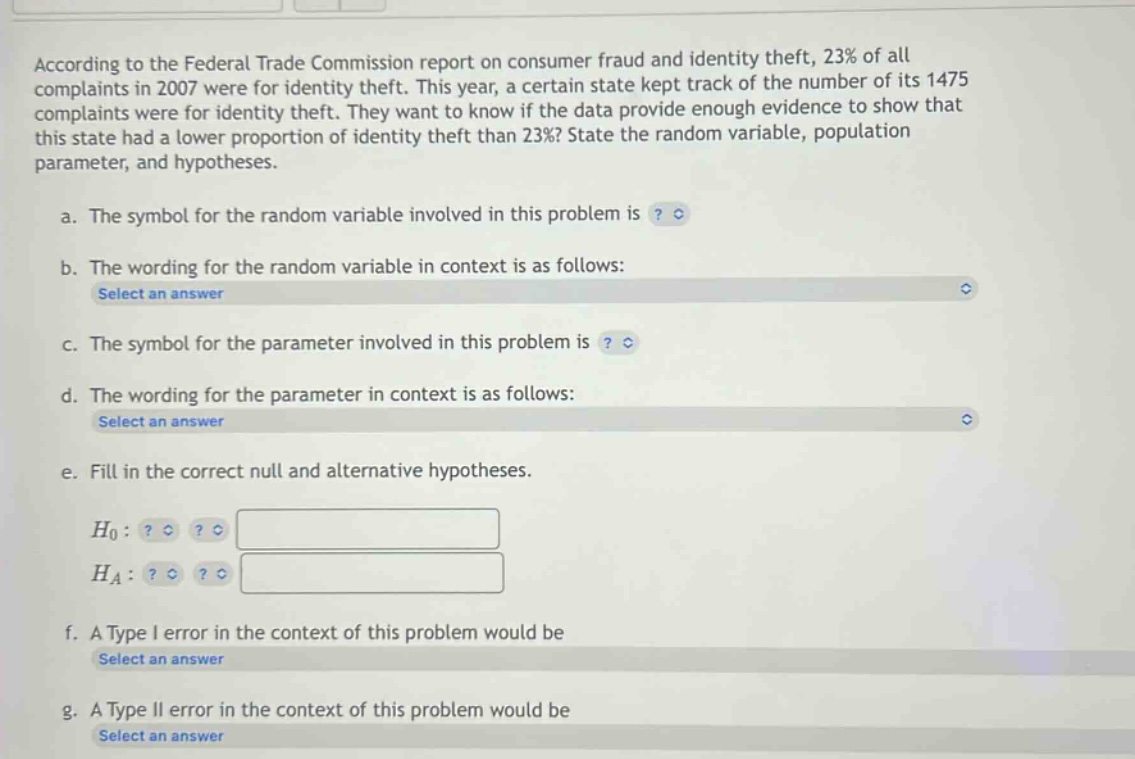
according to the federal trade commission report on consumer fraud and identity theft, 23% of all complaints in 2007 were for identity theft. this year, a certain state kept track of the number of its 1475 complaints were for identity theft. they want to know if the data provide enough evidence to show that this state had a lower proportion of identity theft than 23%? state the random variable, population parameter, and hypotheses.\na. the symbol for the random variable involved in this problem is?\nb. the wording for the random variable in context is as follows: select an answer\nc. the symbol for the parameter involved in this problem is?\nd. the wording for the parameter in context is as follows: select an answer\ne. fill in the correct null and alternative hypotheses.\n$h_0$:?\n$h_a$:?\nf. a type i error in the context of this problem would be select an answer\ng. a type ii error in the context of this problem would be select an answer
Answer
Explanation:
Step1: Define random variable
Let $X$ be the number of identity - theft complaints in the state.
Step2: Define random variable in context
The random variable is the number of identity - theft complaints in the state out of 1475 complaints.
Step3: Define parameter
The parameter is $p$, the proportion of identity - theft complaints in the state.
Step4: Define parameter in context
The parameter is the proportion of identity - theft complaints among all complaints in the state.
Step5: Set up hypotheses
The null hypothesis $H_0:p = 0.23$ and the alternative hypothesis $H_A:p<0.23$.
Step6: Define Type I error
A Type I error is rejecting $H_0$ when $H_0$ is true. In context, it is concluding that the proportion of identity - theft complaints in the state is less than 0.23 when in fact it is 0.23.
Step7: Define Type II error
A Type II error is failing to reject $H_0$ when $H_A$ is true. In context, it is failing to conclude that the proportion of identity - theft complaints in the state is less than 0.23 when in fact it is less than 0.23.
Answer:
a. $X$ b. The number of identity - theft complaints in the state out of 1475 complaints. c. $p$ d. The proportion of identity - theft complaints among all complaints in the state. e. $H_0:p = 0.23$, $H_A:p<0.23$ f. Concluding that the proportion of identity - theft complaints in the state is less than 0.23 when in fact it is 0.23. g. Failing to conclude that the proportion of identity - theft complaints in the state is less than 0.23 when in fact it is less than 0.23.