according to the law of superposition, which of the following is true?\no a. the fossils in layer a are…
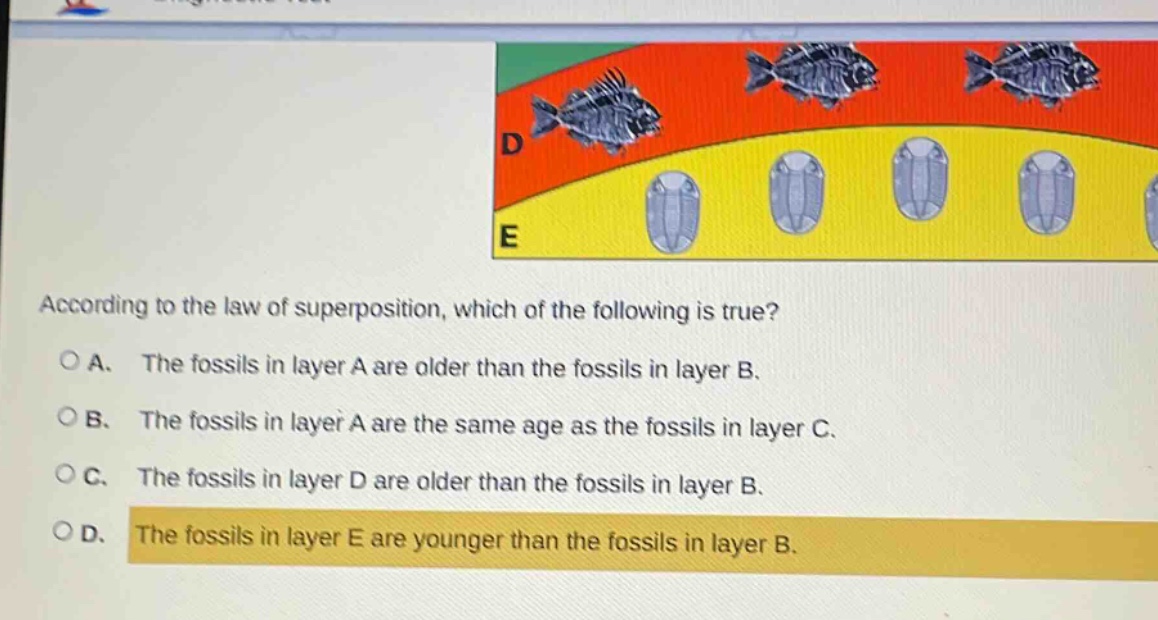
according to the law of superposition, which of the following is true?\no a. the fossils in layer a are older than the fossils in layer b.\no b. the fossils in layer a are the same age as the fossils in layer c.\no c. the fossils in layer d are older than the fossils in layer b.\no d. the fossils in layer e are younger than the fossils in layer b.
Answer
Brief Explanations:
The law of superposition states that in undisturbed sedimentary rock layers, the oldest layers are at the bottom and the youngest are at the top. So, lower - lying fossil layers are older. Layer E is below layer B, meaning fossils in layer E are older than those in layer B. Layer D is above layer B, so fossils in layer D are younger than those in layer B. There is no layer A in the given diagram, but if considering the principle, lower layers have older fossils.
Answer:
None of the options are correct as presented (assuming the diagram has layers D and E and no layer A as shown in the question text). If we assume there was a mis - label and we consider the general principle, the correct understanding is that lower layers have older fossils. If we had to choose based on the options and correct the mis - naming, the principle would imply that if we assume layer E is the lowest shown layer and layer D is above it, fossils in layer E are older than those in layer D and any layer above it. But as the options are written with an incorrect reference to layer A, there is no correct option among A, B, C, D as presented.