aeronautical researchers have developed three different processes to pack a parachute. they want to compare…
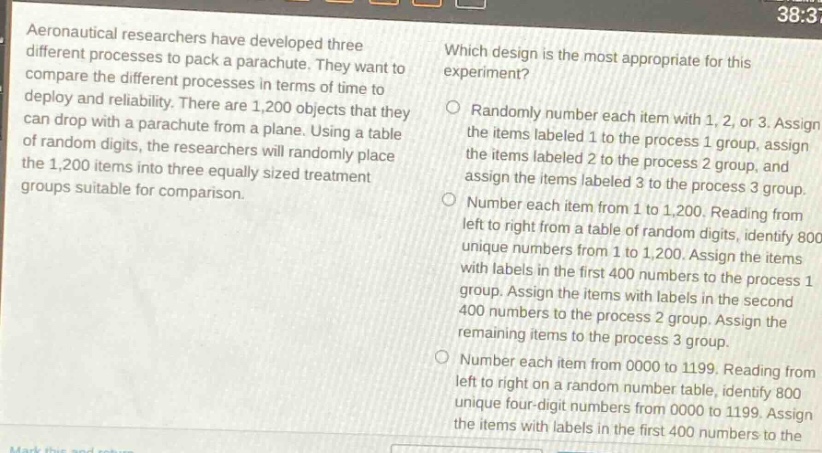
aeronautical researchers have developed three different processes to pack a parachute. they want to compare the different processes in terms of time to deploy and reliability. there are 1,200 objects that they can drop with a parachute from a plane. using a table of random digits, the researchers will randomly place the 1,200 items into three equally sized treatment groups suitable for comparison. which design is the most appropriate for this experiment? randomly number each item with 1, 2, or 3. assign the items labeled 1 to the process 1 group, assign the items labeled 2 to the process 2 group, and assign the items labeled 3 to the process 3 group. number each item from 1 to 1,200. reading from left to right from a table of random digits, identify 800 unique numbers from 1 to 1,200. assign the items with labels in the first 400 numbers to the process 1 group. assign the items with labels in the second 400 numbers to the process 2 group. assign the remaining items to the process 3 group. number each item from 0000 to 1199. reading from left to right on a random number table, identify 800 unique four - digit numbers from 0000 to 1199. assign the items with labels in the first 400 numbers to the
Answer
Answer:
Number each item from 1 to 1,200. Reading from left - to - right from a table of random digits, identify 800 unique numbers from 1 to 1,200. Assign the items with labels in the first 400 numbers to the process 1 group. Assign the items with labels in the second 400 numbers to the process 2 group. Assign the remaining items to the process 3 group.
Explanation:
Step1: Ensure equal - sized groups
We need 3 equal - sized groups from 1200 items, so each group should have 400 items.
Step2: Random number selection
By reading from a table of random digits and selecting unique numbers from 1 - 1200, we ensure random assignment.
Step3: Group assignment
Assigning the first 400 numbers to process 1, the second 400 to process 2, and the remaining to process 3 creates the three treatment groups for comparison.