answer the following questions using the information provided in this chapter.\n1. all of the following…
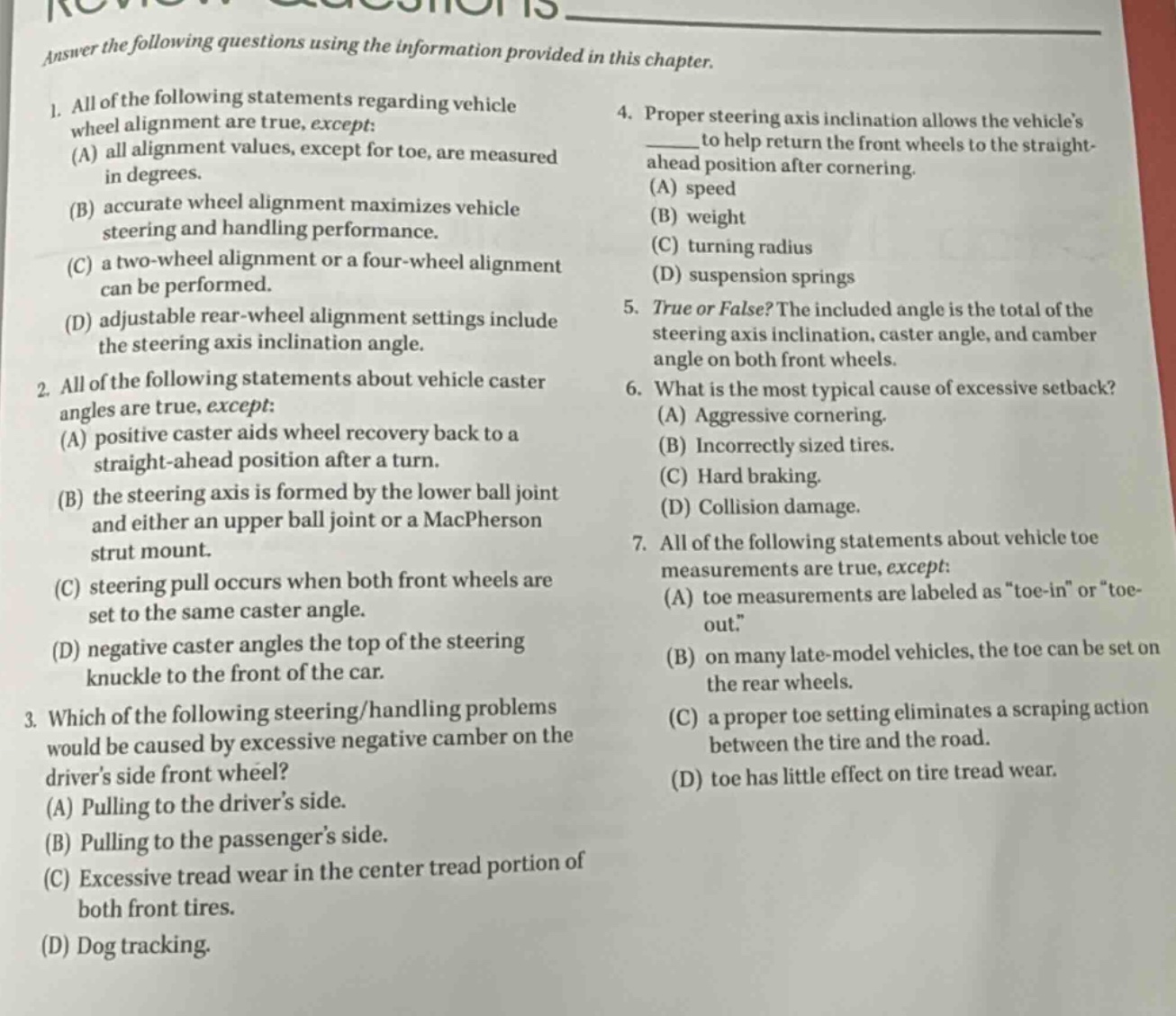
answer the following questions using the information provided in this chapter.\n1. all of the following statements regarding vehicle wheel alignment are true, except:\n(a) all alignment values, except for toe, are measured in degrees.\n(b) accurate wheel alignment maximizes vehicle steering and handling performance.\n(c) a two - wheel alignment or a four - wheel alignment can be performed.\n(d) adjustable rear - wheel alignment settings include the steering axis inclination angle.\n2. all of the following statements about vehicle caster angles are true, except:\n(a) positive caster aids wheel recovery back to a straight - ahead position after a turn.\n(b) the steering axis is formed by the lower ball joint and either an upper ball joint or a macpherson strut mount.\n(c) steering pull occurs when both front wheels are set to the same caster angle.\n(d) negative caster angles the top of the steering knuckle to the front of the car.\n3. which of the following steering/handling problems would be caused by excessive negative camber on the drivers side front wheel?\n(a) pulling to the drivers side.\n(b) pulling to the passengers side.\n(c) excessive tread wear in the center tread portion of both front tires.\n(d) dog tracking.\n4. proper steering axis inclination allows the vehicles ____ to help return the front wheels to the straight - ahead position after cornering.\n(a) speed\n(b) weight\n(c) turning radius\n(d) suspension springs\n5. true or false? the included angle is the total of the steering axis inclination, caster angle, and camber angle on both front wheels.\n6. what is the most typical cause of excessive setback?\n(a) aggressive cornering.\n(b) incorrectly sized tires.\n(c) hard braking.\n(d) collision damage.\n7. all of the following statements about vehicle toe measurements are true, except:\n(a) toe measurements are labeled as \toe - in\ or \toe - out.\\n(b) on many late - model vehicles, the toe can be set on the rear wheels.\n(c) a proper toe setting eliminates a scraping action between the tire and the road.\n(d) toe has little effect on tire tread wear.
Answer
Brief Explanations:
- (D): Steering axis inclination is not an adjustable rear - wheel alignment setting. Toe is measured in inches or millimeters, not degrees for most non - toe alignment values, accurate alignment helps performance, and two or four - wheel alignments are common.
- (C): Steering pull occurs when there is a difference in caster angles between the front wheels, not when they are the same. Positive caster aids wheel return, the steering axis is formed as described, and negative caster has the top of the steering knuckle forward.
- (A): Excessive negative camber on the driver's side front wheel can cause the vehicle to pull to the driver's side.
- (D): Suspension springs help return the front wheels to the straight - ahead position after cornering due to proper steering axis inclination.
- False: The included angle is the sum of the steering axis inclination and camber angle on a single front wheel, not including caster.
- (D): Collision damage is the most typical cause of excessive setback. Aggressive cornering, incorrect tire size, and hard braking are less likely to cause it.
- (D): Toe has a significant effect on tire tread wear. Toe is labeled as toe - in or toe - out, can be set on rear wheels in many late - model vehicles, and a proper toe setting reduces scraping.
Answer:
- D
- C
- A
- D
- False
- D
- D