assume the conditional statement is true. if the invitations are printed on cream paper, then the writing is…
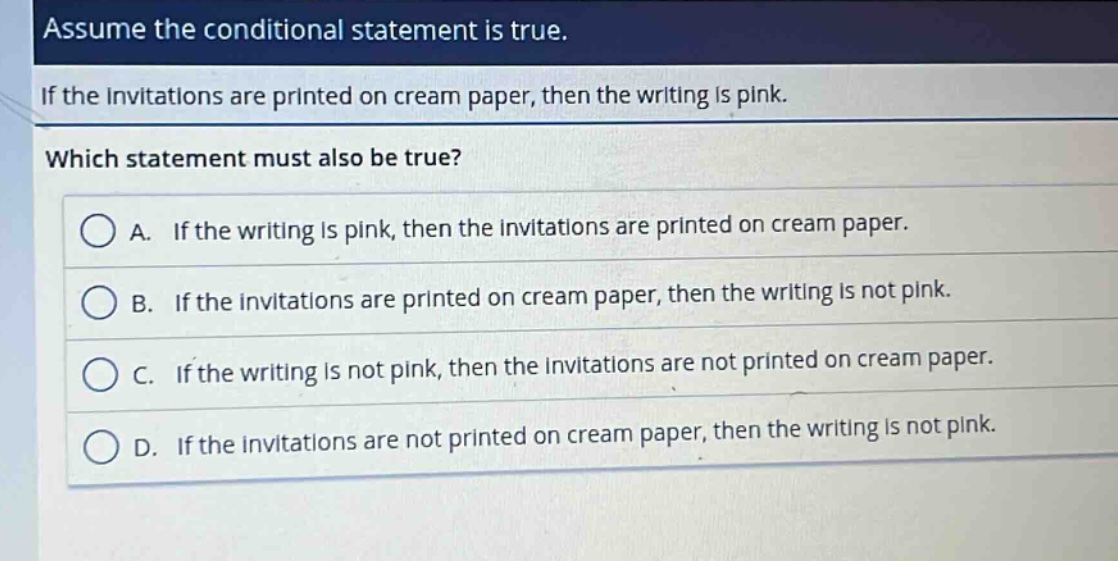
assume the conditional statement is true. if the invitations are printed on cream paper, then the writing is pink. which statement must also be true? a. if the writing is pink, then the invitations are printed on cream paper. b. if the invitations are printed on cream paper, then the writing is not pink. c. if the writing is not pink, then the invitations are not printed on cream paper. d. if the invitations are not printed on cream paper, then the writing is not pink.
Answer
Brief Explanations:
In logic, for a conditional statement "if p then q" (where p is the hypothesis and q is the conclusion), its contra - positive "if not q then not p" has the same truth - value. Here, p is "the invitations are printed on cream paper" and q is "the writing is pink". The contra - positive of the given statement is "If the writing is not pink, then the invitations are not printed on cream paper".
Answer:
C. If the writing is not pink, then the invitations are not printed on cream paper.