calculating the ages of rocks and fossils\ncalculate the ages of these rocks and fossils by using the…
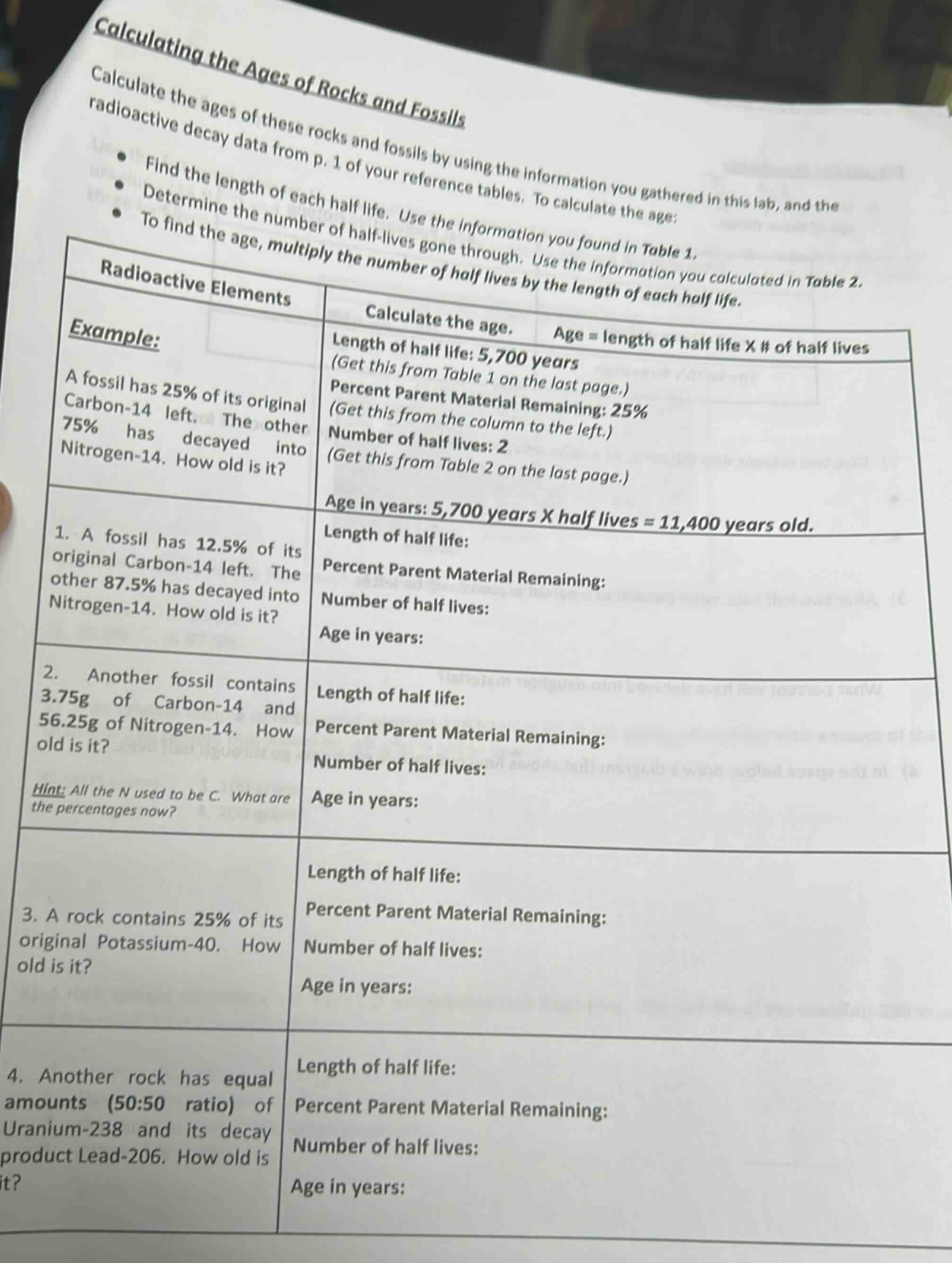
calculating the ages of rocks and fossils\ncalculate the ages of these rocks and fossils by using the information you gathered in this lab, and the radioactive decay data from p. 1 of your reference tables. to calculate the age:\n- find the length of each half - life. use the information you found in table 1.\n- determine the number of half - lives gone through. use the information you calculated in table 2.\n- to find the age, multiply the number of half lives by the length of each half life.\nradioactive elements\nexample:\na fossil has 25% of its original carbon - 14 left. the other 75% has decayed into nitrogen - 14. how old is it?\ncalculate the age. age = length of half life x # of half lives\nlength of half life: 5,700 years (get this from table 1 on the last page.)\npercent parent material remaining: 25% (get this from the column to the left.)\nnumber of half lives: 2 (get this from table 2 on the last page.)\nage in years: 5,700 years x half lives = 11,400 years old.\n1. a fossil has 12.5% of its original carbon - 14 left. the other 87.5% has decayed into nitrogen - 14. how old is it?\nlength of half life:\npercent parent material remaining:\nnumber of half lives:\nage in years:\n2. another fossil contains 3.75g of carbon - 14 and 56.25g of nitrogen - 14. how old is it?\nhint: all the n used to be c. what are the percentages now?\nlength of half life:\npercent parent material remaining:\nnumber of half lives:\nage in years:\n3. a rock contains 25% of its original potassium - 40. how old is it?\nlength of half life:\npercent parent material remaining:\nnumber of half lives:\nage in years:\n4. another rock has equal amounts (50:50 ratio) of uranium - 238 and its decay product lead - 206. how old is it?\nlength of half life:\npercent parent material remaining:\nnumber of half lives:\nage in years:
Answer
Explanation:
Step1: Recall half - life concept
The amount of parent material remaining after $n$ half - lives is given by $P = (\frac{1}{2})^n$, where $P$ is the proportion of parent material remaining.
Step2: Solve for problem 1
- Given $P = 0.125$. Since $P=(\frac{1}{2})^n$, then $0.125=\frac{1}{8}=(\frac{1}{2})^3$. So $n = 3$.
- The half - life of Carbon - 14 is 5700 years.
- Age = length of half - life $\times$ number of half - lives. Age $=5700\times3 = 17100$ years.
- Length of half life: 5700 years
- Percent Parent Material Remaining: 12.5%
- Number of half lives: 3
- Age in years: 17100 years
Step3: Solve for problem 2
- The total amount of material originally was $3.75 + 56.25=60$g. The proportion of parent material (Carbon - 14) remaining is $P=\frac{3.75}{60}=0.0625$.
- Since $P = (\frac{1}{2})^n$, and $0.0625=\frac{1}{16}=(\frac{1}{2})^4$, so $n = 4$.
- The half - life of Carbon - 14 is 5700 years.
- Age = 5700×4 = 22800 years.
- Length of half life: 5700 years
- Percent Parent Material Remaining: 6.25%
- Number of half lives: 4
- Age in years: 22800 years
Step4: Solve for problem 3
- Given $P = 0.25$. Since $P=(\frac{1}{2})^n$, then $0.25=\frac{1}{4}=(\frac{1}{2})^2$. So $n = 2$.
- Assume the half - life of Potassium - 40 is $t$ (from reference table, say $t = 1.25\times10^{9}$ years).
- Age = $1.25\times10^{9}\times2=2.5\times10^{9}$ years.
- Length of half life: $1.25\times10^{9}$ years
- Percent Parent Material Remaining: 25%
- Number of half lives: 2
- Age in years: $2.5\times10^{9}$ years
Step5: Solve for problem 4
- Given $P = 0.5$. Since $P=(\frac{1}{2})^n$, then $n = 1$.
- Assume the half - life of Uranium - 238 is $t$ (from reference table, say $t = 4.47\times10^{9}$ years).
- Age = $4.47\times10^{9}\times1 = 4.47\times10^{9}$ years.
- Length of half life: $4.47\times10^{9}$ years
- Percent Parent Material Remaining: 50%
- Number of half lives: 1
- Age in years: $4.47\times10^{9}$ years
Answer:
- Length of half life: 5700 years
- Percent Parent Material Remaining: 12.5%
- Number of half lives: 3
- Age in years: 17100 years
- Length of half life: 5700 years
- Percent Parent Material Remaining: 6.25%
- Number of half lives: 4
- Age in years: 22800 years
- Length of half life: $1.25\times10^{9}$ years
- Percent Parent Material Remaining: 25%
- Number of half lives: 2
- Age in years: $2.5\times10^{9}$ years
- Length of half life: $4.47\times10^{9}$ years
- Percent Parent Material Remaining: 50%
- Number of half lives: 1
- Age in years: $4.47\times10^{9}$ years