5. a chemistry teacher gives a pop quiz to see if the students read last night’s assignment. the teacher…
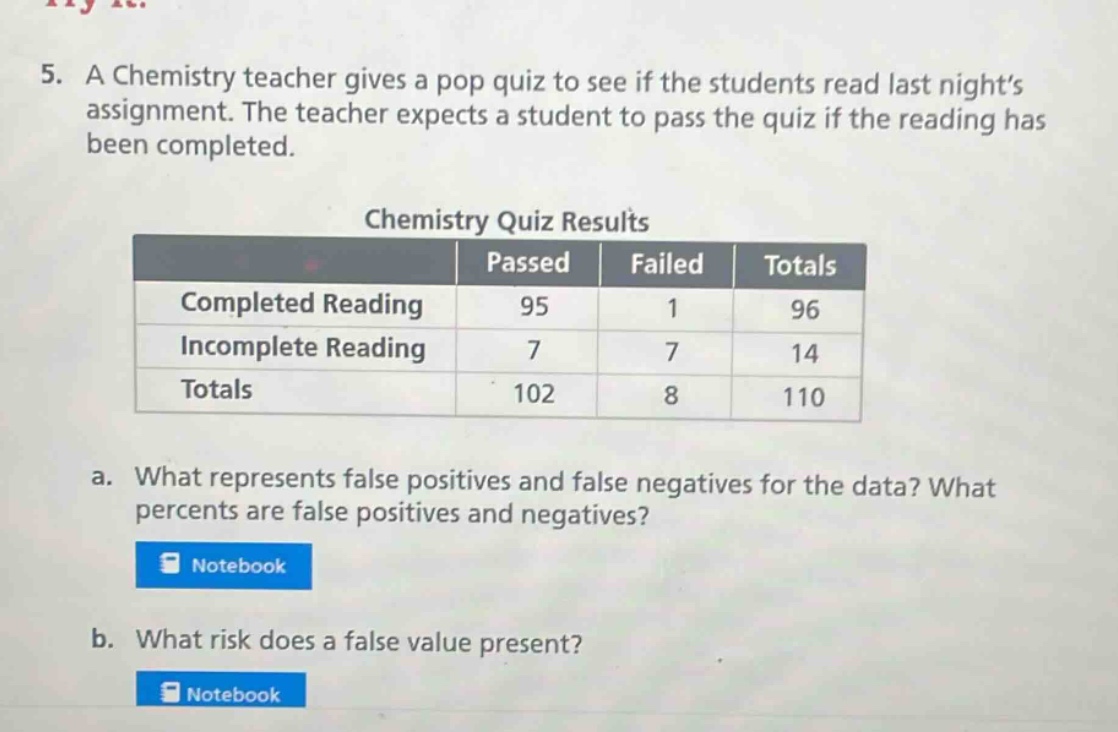
5. a chemistry teacher gives a pop quiz to see if the students read last night’s assignment. the teacher expects a student to pass the quiz if the reading has been completed.\n\nchemistry quiz results\n| | passed | failed | totals |\n|--|--|--|--|\n| completed reading | 95 | 1 | 96 |\n| incomplete reading | 7 | 7 | 14 |\n| totals | 102 | 8 | 110 |\n\na. what represents false positives and false negatives for the data? what percents are false positives and negatives?\nb. what risk does a false value present?
Answer
Explanation:
Step1: Define false - positive and false - negative
A false - positive is when a student passes the quiz but did not complete the reading. A false - negative is when a student fails the quiz but completed the reading.
Step2: Calculate the number of false - positives and false - negatives
False - positives: 7 (students who passed but did not complete reading). False - negatives: 1 (student who failed but completed reading).
Step3: Calculate the percentage of false - positives
The percentage of false - positives is $\frac{7}{110}\times100\approx 6.36%$.
Step4: Calculate the percentage of false - negatives
The percentage of false - negatives is $\frac{1}{110}\times100\approx 0.91%$.
Step5: Answer part b
A false - positive may give the teacher a false impression that the student has understood the material when they haven't, potentially leading to inappropriate pacing in teaching. A false - negative may make the teacher think the student has not understood when they actually have, which could lead to unnecessary additional instruction or lower grades for the student.
Answer:
a. False - positives: 7 students who passed but did not complete reading, approximately 6.36%. False - negatives: 1 student who failed but completed reading, approximately 0.91%. b. False - positives can mislead teachers about student understanding and affect teaching pace. False - negatives can lead to unnecessary additional instruction or unfair grading.