1. define the term computer, including its purpose, components, and types of computers. 10 marks\n2. list…
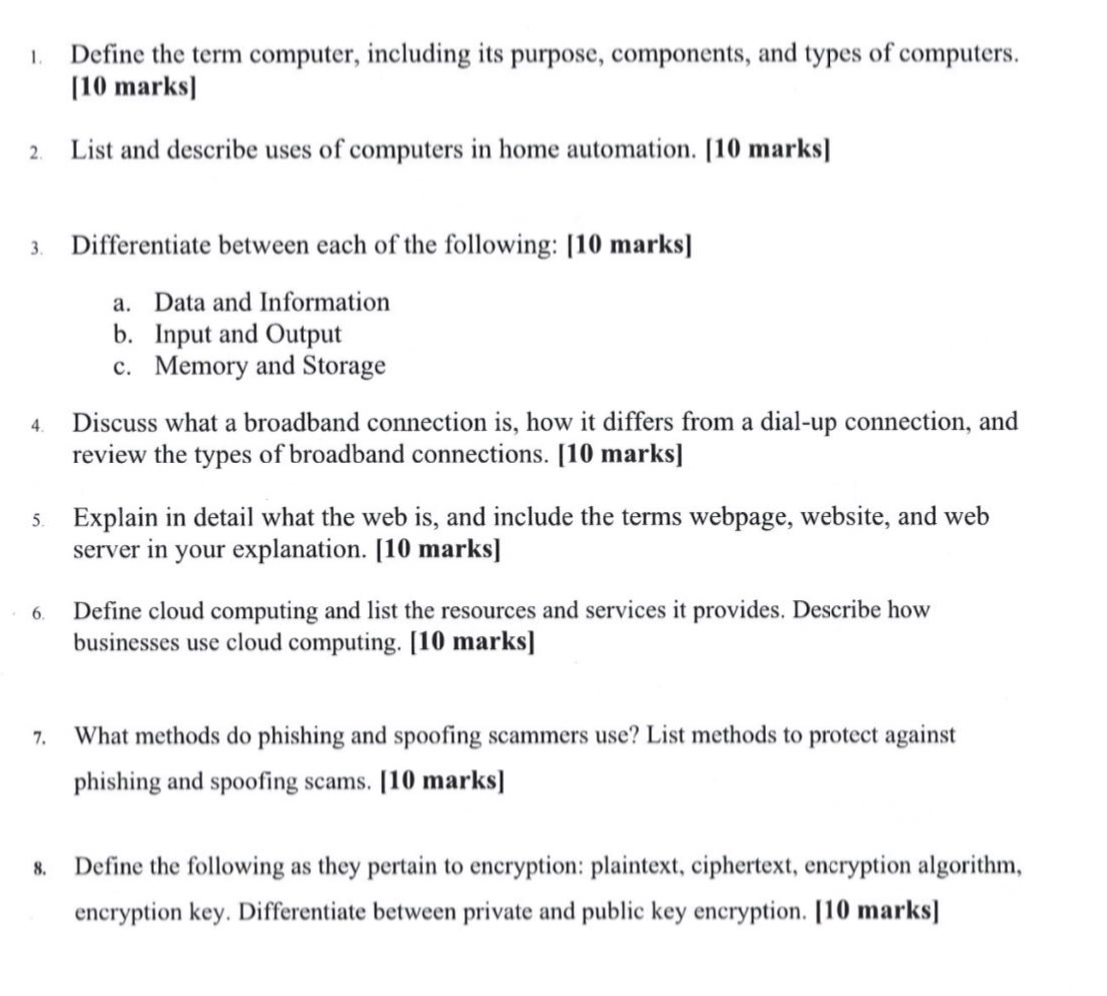
1. define the term computer, including its purpose, components, and types of computers. 10 marks\n2. list and describe uses of computers in home automation. 10 marks\n3. differentiate between each of the following: 10 marks\n a. data and information\n b. input and output\n c. memory and storage\n4. discuss what a broadband connection is, how it differs from a dial - up connection, and review the types of broadband connections. 10 marks\n5. explain in detail what the web is, and include the terms webpage, website, and web server in your explanation. 10 marks\n6. define cloud computing and list the resources and services it provides. describe how businesses use cloud computing. 10 marks\n7. what methods do phishing and spoofing scammers use? list methods to protect against phishing and spoofing scams. 10 marks\n8. define the following as they pertain to encryption: plaintext, ciphertext, encryption algorithm, encryption key. differentiate between private and public key encryption. 10 marks
Answer
Brief Explanations:
- A computer is an electronic device for processing data. Its purpose is to perform various tasks like calculations, information - handling. Components include CPU, memory, storage, input and output devices. Types are personal, server, supercomputers etc.
- In home automation, computers control lighting, temperature, security systems etc. They can be programmed to automate daily tasks.
- a. Data is raw facts, information is processed data. b. Input is data entered into a system, output is the result produced. c. Memory is temporary storage for immediate use, storage is long - term.
- Broadband is a high - speed internet connection. It's faster and always - on compared to dial - up. Types include DSL, cable, fiber etc.
- The web is a global system of interconnected documents. A webpage is a single document, a website is a collection of webpages, and a web server hosts and serves webpages.
- Cloud computing is delivering computing services over the internet. Resources include storage, processing power. Services are IaaS, PaaS, SaaS. Businesses use it for cost - savings, scalability.
- Phishing scammers use fake emails, websites. Spoofing scammers fake identities. Protection methods include verifying sources, using anti - phishing software.
- Plaintext is unencrypted data, ciphertext is encrypted. Encryption algorithm is the method, encryption key is used to encrypt/decrypt. Private key encryption uses one key, public key uses two.
Answer:
- A computer is an electronic device that manipulates data or information. Its purpose is to perform arithmetic and logical operations as per user - given instructions. Components include the central processing unit (CPU), memory (RAM), storage devices (hard drive, SSD), input devices (keyboard, mouse) and output devices (monitor, printer). Types of computers include personal computers (desktop, laptop), servers, supercomputers, and mainframe computers.
- In home automation, computers are used for controlling lighting systems (dimming lights, scheduling on/off times), temperature control (adjusting thermostat settings), security systems (monitoring cameras, controlling access), and home entertainment systems (controlling audio - video devices).
- a. Data are raw facts and figures, unprocessed and without context. Information is data that has been processed, organized, and given context to be meaningful. b. Input is the data or instructions that are entered into a computer system. Output is the result or response generated by the computer system after processing the input. c. Memory (RAM) is a volatile storage that holds data and instructions temporarily for immediate use by the CPU. Storage (hard drive, SSD) is non - volatile and used for long - term storage of data and programs.
- A broadband connection is a high - speed internet connection that allows for faster data transfer rates compared to dial - up. It is always on, while dial - up requires a connection to be established each time. Types of broadband connections include Digital Subscriber Line (DSL), cable internet, fiber - optic internet, and satellite internet.
- The web, or World Wide Web, is a system of interconnected documents and other resources, linked by hyperlinks and URLs. A webpage is a single document on the web, usually written in HTML. A website is a collection of related webpages. A web server is a computer program or a physical computer that stores webpages and serves them to clients (such as web browsers) over the internet.
- Cloud computing is the delivery of computing services—including servers, storage, databases, networking, software, analytics, and intelligence—over the Internet (“the cloud”) to offer faster innovation, flexible resources, and economies of scale. Resources and services include Infrastructure as a Service (IaaS), Platform as a Service (PaaS), and Software as a Service (SaaS). Businesses use cloud computing for cost - savings (no need for large on - premise infrastructure), scalability (easily adjust resources as needed), and increased collaboration.
- Phishing scammers use fake emails that appear to be from legitimate sources, often asking for personal information like passwords or credit card numbers. They also create fake websites that mimic real ones. Spoofing scammers fake their identity, such as spoofing an email address or IP address. Protection methods include being cautious of unsolicited emails, verifying the authenticity of websites (checking URLs), using anti - phishing software, and keeping software up - to - date.
- Plaintext is the original, unencrypted data. Ciphertext is the encrypted form of the plaintext. An encryption algorithm is the mathematical formula used to convert plaintext to ciphertext and vice versa. An encryption key is a value that is used with the encryption algorithm to encrypt or decrypt data. In private key encryption, the same key is used for both encryption and decryption. In public key encryption, there are two keys: a public key for encryption and a private key for decryption.