8. describe how all living organisms end up containing both carbon - 12 and carbon - 14. 9. why does…
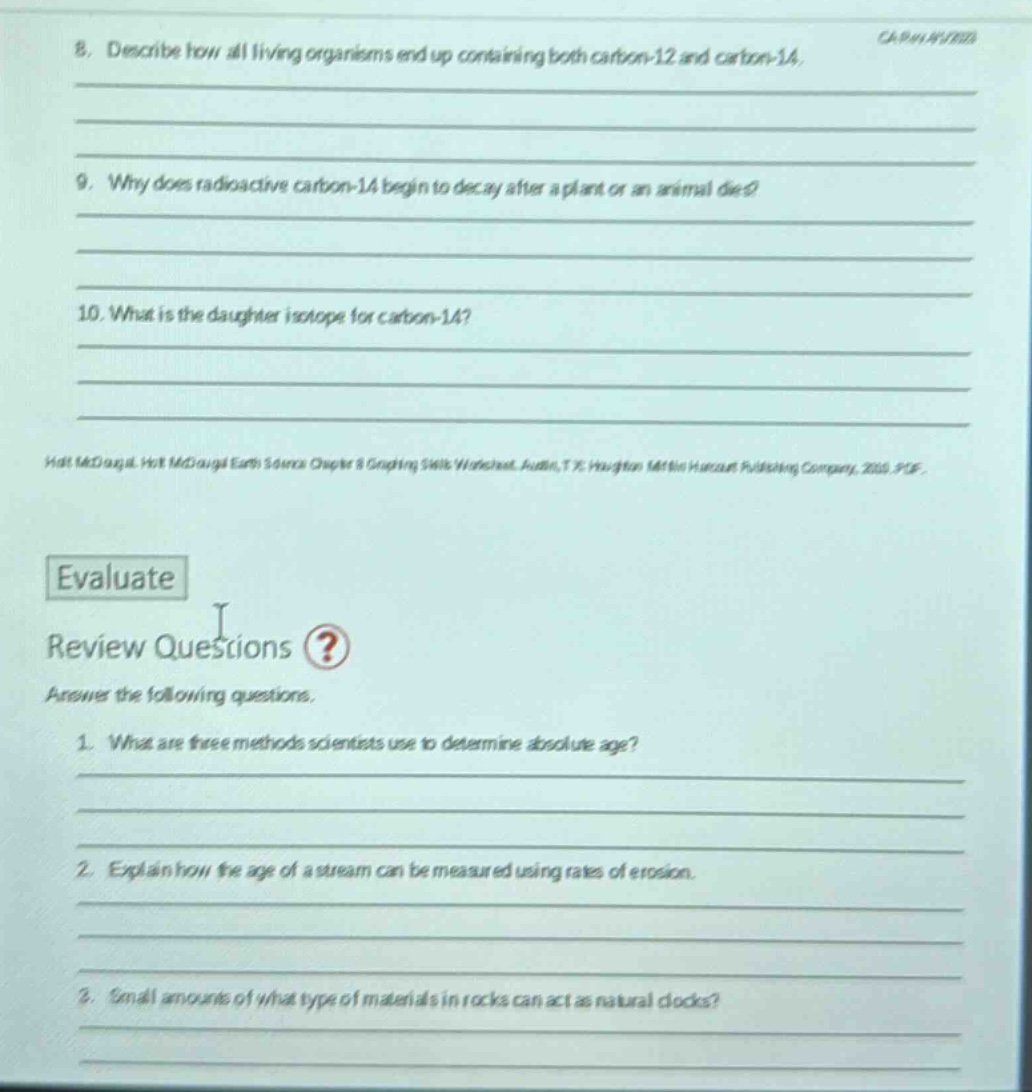
8. describe how all living organisms end up containing both carbon - 12 and carbon - 14. 9. why does radioactive carbon - 14 begin to decay after a plant or an animal dies? 10. what is the daughter isotope for carbon - 14? holt mcdougal holt mcdougal earth science chapter 8 graphing skills worksheets austin, tx: houghton mifflin harcourt publishing company, 2010 p62 evaluate review questions? answer the following questions. 1. what are three methods scientists use to determine absolute age? 2. explain how the age of a stream can be measured using rates of erosion. 3. small amounts of what type of materials in rocks can act as natural clocks?
Answer
Brief Explanations:
- Living organisms take in carbon - 12 and carbon - 14 from the environment during life processes like photosynthesis and respiration. Carbon - 12 is stable and abundant, while carbon - 14 is a radioactive isotope constantly being formed in the atmosphere and incorporated into living things.
- While alive, organisms maintain a balance of carbon - 14 through intake and output. After death, the intake stops, and the existing carbon - 14 begins to decay because it is unstable and undergoes radioactive decay to reach a more stable state.
- Carbon - 14 undergoes beta - decay, and its daughter isotope is nitrogen - 14.
- Three methods to determine absolute age are radiometric dating (using the decay of radioactive isotopes), dendrochronology (using tree - rings), and stratigraphy (examining rock layers).
- The age of a stream can be estimated by measuring the rate of erosion of its channel. If the depth or width of the channel and the rate of erosion per year are known, the time elapsed (age) can be calculated by dividing the total amount of erosion by the annual erosion rate.
- Small amounts of radioactive materials in rocks can act as natural clocks. Radioactive isotopes decay at a known, constant rate, and by measuring the ratio of parent to daughter isotopes, the age of the rock can be determined.
Answer:
- Living organisms take in carbon - 12 and carbon - 14 from the environment during life - related processes.
- After death, intake of carbon - 14 stops and it decays as it is unstable.
- Nitrogen - 14.
- Radiometric dating, dendrochronology, stratigraphy.
- Measure erosion rate of channel, divide total erosion by annual rate to estimate age.
- Radioactive materials.