determine whether the statement is true or false. p → q can be translated as \p is necessary for q.\ choose…
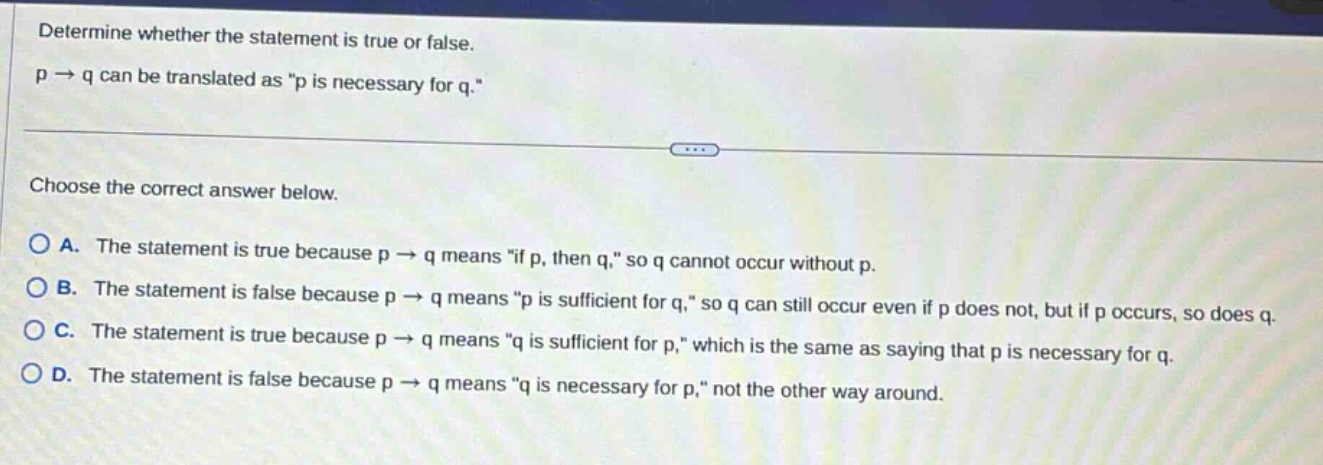
determine whether the statement is true or false. p → q can be translated as \p is necessary for q.\ choose the correct answer below. a. the statement is true because p → q means \if p, then q,\ so q cannot occur without p. b. the statement is false because p → q means \p is sufficient for q,\ so q can still occur even if p does not, but if p occurs, so does q. c. the statement is true because p → q means \q is sufficient for p,\ which is the same as saying that p is necessary for q. d. the statement is false because p → q means \q is necessary for p,\ not the other way around.
Answer
Brief Explanations:
The conditional statement $p\rightarrow q$ is read as "if $p$, then $q$", which means $p$ is sufficient for $q$. That is, if $p$ occurs, $q$ occurs, but $q$ can occur even when $p$ does not. It is not the case that $p$ is necessary for $q$.
Answer:
B. The statement is false because $p\rightarrow q$ means "p is sufficient for q," so q can still occur even if p does not, but if p occurs, so does q.