the diagram shows three sedimentary rock layers and an igneous intrusion. what is the relative age of…
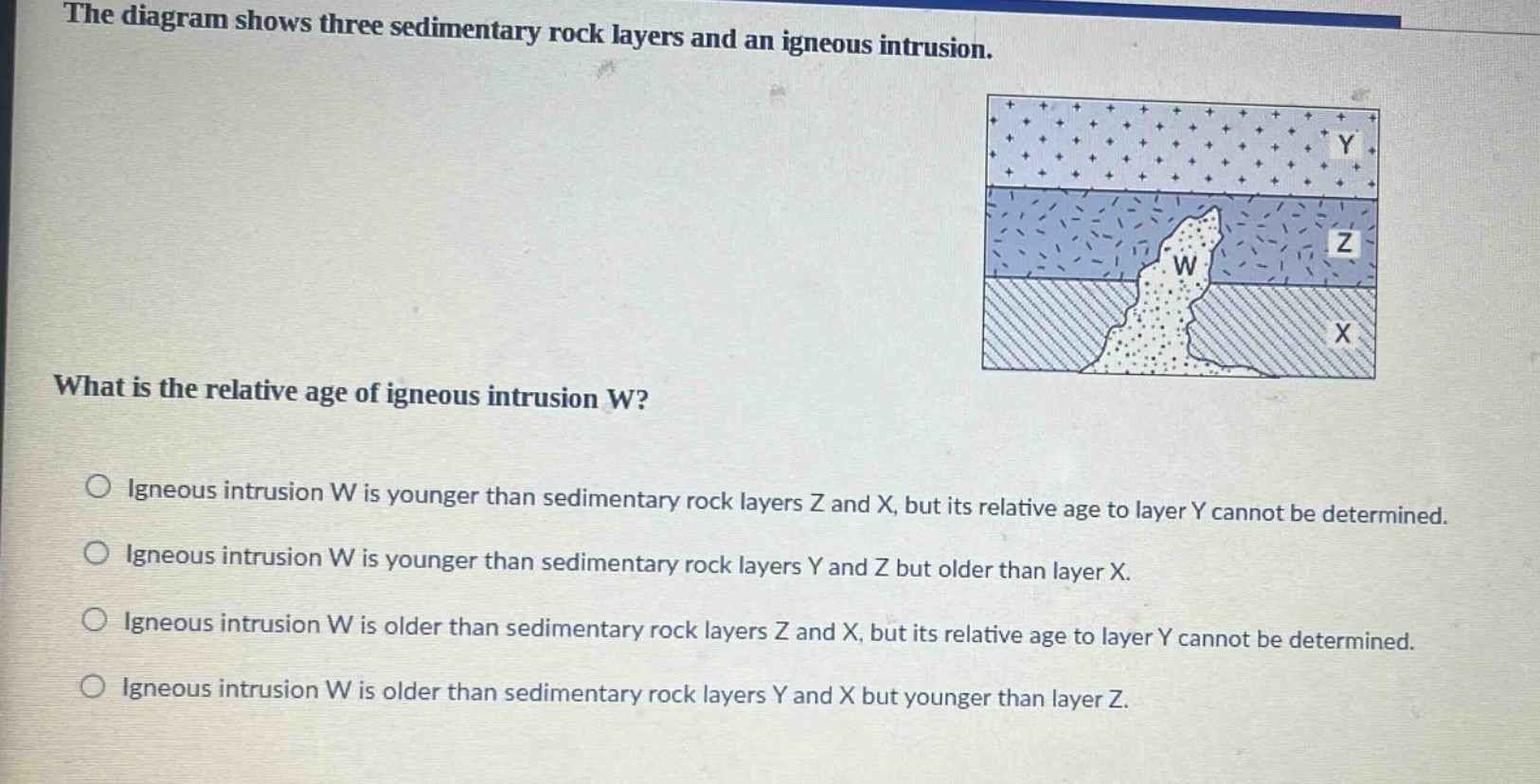
the diagram shows three sedimentary rock layers and an igneous intrusion. what is the relative age of igneous intrusion w? igneous intrusion w is younger than sedimentary rock layers z and x, but its relative age to layer y cannot be determined. igneous intrusion w is younger than sedimentary rock layers y and z but older than layer x. igneous intrusion w is older than sedimentary rock layers z and x, but its relative age to layer y cannot be determined. igneous intrusion w is older than sedimentary rock layers y and x but younger than layer z.
Answer
Brief Explanations:
The principle of cross - cutting relationships states that an igneous intrusion is younger than the rocks it cuts through. Igneous intrusion W cuts through sedimentary rock layers X and Z. There is no information indicating its relationship with layer Y. So, it is younger than X and Z, but its age relative to Y cannot be determined.
Answer:
Igneous intrusion W is younger than sedimentary rock layers Z and X, but its relative age to layer Y cannot be determined.