9. diamonds are the hardest natural substance known. you can, however, easily break a diamond into several…
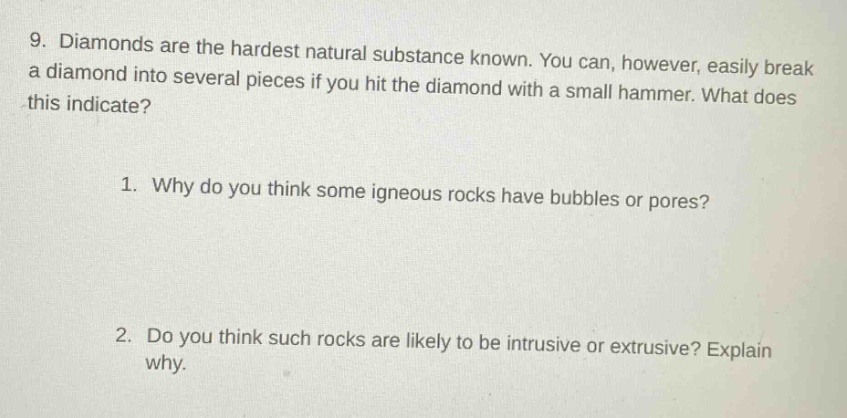
9. diamonds are the hardest natural substance known. you can, however, easily break a diamond into several pieces if you hit the diamond with a small hammer. what does this indicate? 1. why do you think some igneous rocks have bubbles or pores? 2. do you think such rocks are likely to be intrusive or extrusive? explain why.
Answer
Brief Explanations:
- Diamonds are hard in terms of resistance to scratching due to their strong covalent - bond network. However, they are brittle because the bonds can be broken along certain planes when a sudden impact (like from a hammer) is applied.
- Some igneous rocks have bubbles or pores because when magma or lava cools, dissolved gases within it are released. As the rock solidifies, these escaping gases leave behind voids or pores.
- Rocks with bubbles or pores are likely extrusive. This is because extrusive rocks form when lava cools quickly on the Earth's surface. The rapid cooling doesn't allow enough time for gases to fully escape before solidification, trapping them as bubbles or pores. In contrast, intrusive rocks cool slowly beneath the surface, giving gases more time to escape.
Answer:
- Diamonds are hard but brittle.
- Gases are released during cooling of magma/lava, leaving voids.
- Extrusive; rapid surface - cooling traps gases as pores.