directions: determine whether the following arguments are valid. if it is valid, then identify the rule of…
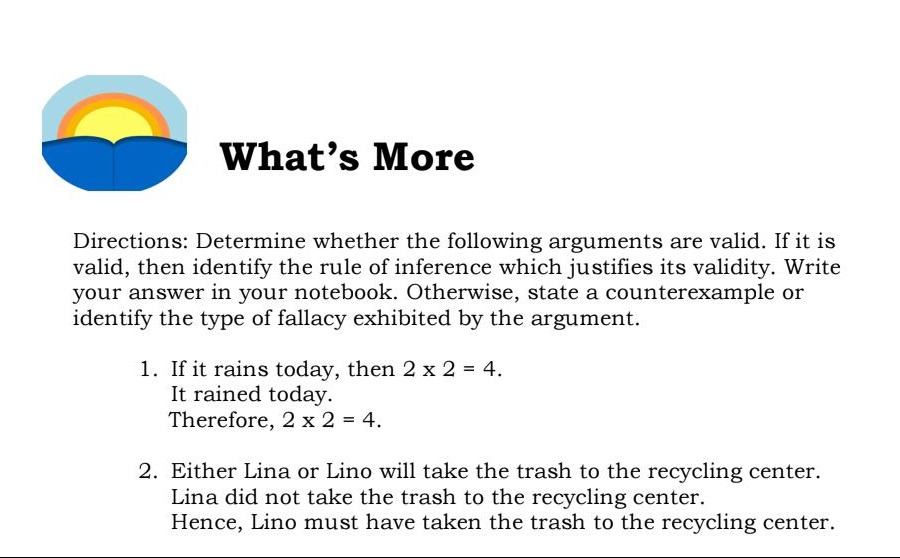
directions: determine whether the following arguments are valid. if it is valid, then identify the rule of inference which justifies its validity. write your answer in your notebook. otherwise, state a counterexample or identify the type of fallacy exhibited by the argument. 1. if it rains today, then 2 x 2 = 4. it rained today. therefore, 2 x 2 = 4. 2. either lina or lino will take the trash to the recycling center. lina did not take the trash to the recycling center. hence, lino must have taken the trash to the recycling center.
Answer
Explanation:
Step1: Identify the form of the argument
The argument is in the form of modus ponens. Let (p) be "It rains today" and (q) be "2 x 2 = 4". The first - premise is (p\rightarrow q), the second - premise is (p), and the conclusion is (q).
Step2: Apply the rule of inference
Modus ponens states that if (p\rightarrow q) is true and (p) is true, then (q) is true. Here, the first premise "If it rains today, then 2 x 2 = 4" is true (since (2\times2 = 4) is always true regardless of the weather), and the second premise "It rained today" is given. So, by modus ponens, the conclusion "2 x 2 = 4" is valid.
Answer:
Valid, by modus ponens.
Explanation:
Step1: Identify the form of the argument
The argument is in the form of disjunctive syllogism. Let (p) be "Lina will take the trash to the recycling center" and (q) be "Lino will take the trash to the recycling center". The first - premise is (p\vee q), the second - premise is (\neg p), and the conclusion is (q).
Step2: Apply the rule of inference
Disjunctive syllogism states that if (p\vee q) is true and (\neg p) is true, then (q) is true. The first premise "Either Lina or Lino will take the trash to the recycling center" is a disjunction, and the second premise "Lina did not take the trash to the recycling center" is the negation of one of the disjuncts. So, by disjunctive syllogism, the conclusion "Lino must have taken the trash to the recycling center" is valid.
Answer:
Valid, by disjunctive syllogism.