directions: use the following information and diagram to answer questions 4 and 5. scientists studied the…
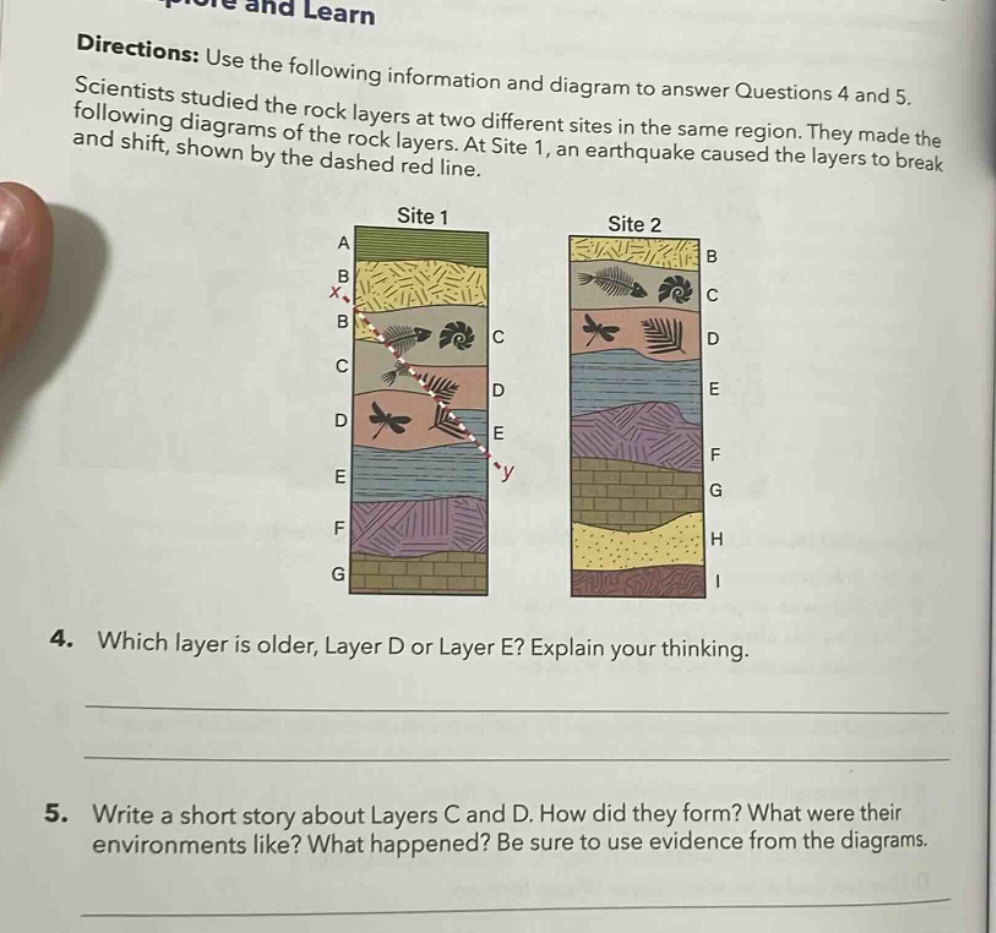
directions: use the following information and diagram to answer questions 4 and 5. scientists studied the rock layers at two different sites in the same region. they made the following diagrams of the rock layers. at site 1, an earthquake caused the layers to break and shift, shown by the dashed red line. 4. which layer is older, layer d or layer e? explain your thinking. 5. write a short story about layers c and d. how did they form? what were their environments like? what happened? be sure to use evidence from the diagrams.
Answer
Answer:
Question 4
Layer E is older.
Question 5
Layers C and D likely formed in different ancient environments. Layer C has fossils of fish - like creatures, suggesting it formed in a water - based environment, perhaps a shallow sea or lake. Over time, sediment accumulated and compressed to form this layer. Layer D has fossils of insects and plants, indicating a terrestrial environment. Maybe there was a period when the water receded, and plants and insects thrived on the land. Eventually, more sediment covered this land environment, forming Layer D. An earthquake later affected Site 1, breaking and shifting the rock layers as shown.
Explanation:
Question 4
Step1: Apply law of superposition
In undisturbed rock layers, the lower layers are older. In both Site 1 and Site 2, Layer E is below Layer D, so Layer E is older.
Question 5
Step1: Analyze fossils in Layer C
The fish - like fossils in Layer C imply a water environment. Sedimentation in water led to layer formation.
Step2: Analyze fossils in Layer D
The insect and plant fossils in Layer D imply a terrestrial environment. Land - based sedimentation formed this layer.
Step3: Consider geological events
The earthquake at Site 1 is an important geological event that affected the rock layers after their formation.