1. draw the xor & xnor equivalent using nand and nor as universal gate\n2. enumerate & define the scale of…
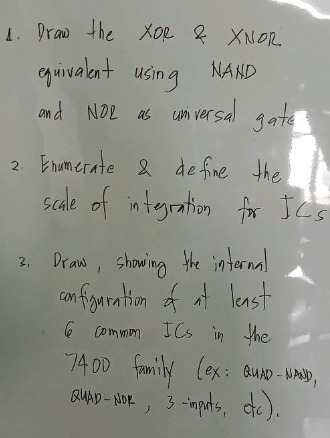
1. draw the xor & xnor equivalent using nand and nor as universal gate\n2. enumerate & define the scale of integration for ics\n3. draw, showing the internal configuration of at least 6 common ics in the 7400 family (ex: quad - 2and, quad - 2nor, 3 - inpute, etc).
Answer
- XOR and XNOR using NAND and NOR as universal gates:
- XOR in terms of NAND:
- The XOR operation (A\oplus B=(A\overline{B}+\overline{A}B)).
- First, we know that (A\overline{B}=\overline{\overline{A\overline{B}}}=\overline{A + B}) (using De - Morgan's law) and (\overline{A}B=\overline{\overline{\overline{A}B}}=\overline{\overline{A}+B}).
- (A\oplus B=\overline{\overline{(A\overline{B}+\overline{A}B)}}).
- We can express (A\oplus B) using only NAND gates as follows:
- (A\oplus B = ((A\ NAND\ A)\ NAND\ B)\ NAND\ ((B\ NAND\ B)\ NAND\ A))
- Let's prove it step - by - step.
- Recall that (A\ NAND\ B=\overline{AB}).
- ((A\ NAND\ A)=\overline{AA}=\overline{A}), ((B\ NAND\ B)=\overline{BB}=\overline{B}).
- (((A\ NAND\ A)\ NAND\ B)=\overline{\overline{A}B}=A + \overline{B}), (((B\ NAND\ B)\ NAND\ A)=\overline{\overline{B}A}=B+\overline{A}).
- (((A\ NAND\ A)\ NAND\ B)\ NAND\ ((B\ NAND\ B)\ NAND\ A)=\overline{(A + \overline{B})(B+\overline{A})}=A\overline{B}+\overline{A}B = A\oplus B).
- For XNOR ((A\odot B=\overline{A\oplus B}=AB+\overline{A}\overline{B})), we can use the fact that (A\odot B=(A\ NAND\ \overline{B})\ NAND\ (\overline{A}\ NAND\ B)). Since (\overline{A}=A\ NAND\ A) and (\overline{B}=B\ NAND\ B), we can further expand it in terms of only NAND gates.
- In terms of NOR gates:
- (A\oplus B=\overline{(\overline{A}\ NOR\ B)\ NOR(A\ NOR\ \overline{B})}).
- First, (\overline{A}=A\ NOR\ A) and (\overline{B}=B\ NOR\ B).
- (\overline{A}\ NOR\ B=\overline{\overline{A}+B}=A\overline{B}) and (A\ NOR\ \overline{B}=\overline{A + \overline{B}}=\overline{A}B).
- (\overline{(\overline{A}\ NOR\ B)\ NOR(A\ NOR\ \overline{B})}=A\overline{B}+\overline{A}B = A\oplus B).
- For XNOR, (A\odot B=\overline{A}\ NOR\ \overline{B}) (using De - Morgan's law and properties of NOR). Since (\overline{A}=A\ NOR\ A) and (\overline{B}=B\ NOR\ B), we can express it fully in terms of NOR gates.
- XOR in terms of NAND:
Explanation:
Step1: Recall XOR and XNOR logic expressions
(A\oplus B = A\overline{B}+\overline{A}B), (A\odot B=\overline{A\oplus B}=AB + \overline{A}\overline{B})
Step2: Use De - Morgan's law and NAND/NOR properties
For NAND: (A\ NAND\ B=\overline{AB}), for NOR: (A\ NOR\ B=\overline{A + B})
Step3: Substitute and simplify
For example, when expressing XOR in NAND, substitute (\overline{A}=A\ NAND\ A) and simplify the overall expression.
Answer:
XOR using NAND: (((A\ NAND\ A)\ NAND\ B)\ NAND\ ((B\ NAND\ B)\ NAND\ A)) XOR using NOR: (\overline{(\overline{A}\ NOR\ B)\ NOR(A\ NOR\ \overline{B})}) XNOR using NAND: ((A\ NAND\ \overline{B})\ NAND\ (\overline{A}\ NAND\ B)) XNOR using NOR: (\overline{A}\ NOR\ \overline{B})
- Scale of integration for ICs:
- Small - Scale Integration (SSI):
- SSI chips typically contain up to 100 logic gates. These are used for simple functions such as single - gate or a few - gate combinations like basic logic gates (AND, OR, NOT), flip - flops.
- Medium - Scale Integration (MSI):
- MSI chips have between 100 and 1000 logic gates. Examples include decoders, multiplexers, counters. These are used to perform more complex but still relatively simple digital functions.
- Large - Scale Integration (LSI):
- LSI chips contain between 1000 and 100000 logic gates. Microprocessors in the early days of personal computing were often LSI chips. They can perform complex operations like arithmetic and logic units in a computer.
- Very - Large - Scale Integration (VLSI):
- VLSI chips have more than 100000 logic gates. Modern microprocessors, memory chips (e.g., DRAM, SRAM), and complex System - on - Chip (SoC) devices are VLSI. They can integrate an entire computer system on a single chip.
- Ultra - Large - Scale Integration (ULSI):
- ULSI refers to chips with millions or billions of transistors (equivalent to a very large number of logic gates). These are used in high - performance computing, advanced mobile devices, and other high - end applications.
- Small - Scale Integration (SSI):
Explanation:
Step1: Define SSI
Up to 100 logic gates, simple functions.
Step2: Define MSI
100 - 1000 logic gates, more complex functions.
Step3: Define LSI
1000 - 100000 logic gates, early microprocessors.
Step4: Define VLSI
100000 logic gates, modern chips.
Step5: Define ULSI
Millions or billions of transistors, high - end applications.
Answer:
SSI: Up to 100 logic gates, simple functions. MSI: 100 - 1000 logic gates, more complex functions. LSI: 1000 - 100000 logic gates, early microprocessors. VLSI: > 100000 logic gates, modern chips. ULSI: Millions or billions of transistors, high - end applications.
- Internal configuration of 7400 family ICs:
- 7400 Quad 2 - input NAND gate:
- It contains four independent 2 - input NAND gates. Each NAND gate has two input pins ((A) and (B)) and one output pin ((Y)). The internal circuit consists of transistors arranged in a way to implement the NAND logic function (Y=\overline{AB}).
- 7402 Quad 2 - input NOR gate:
- It has four independent 2 - input NOR gates. Each NOR gate has two input pins ((A) and (B)) and one output pin ((Y)), with the internal circuit implementing (Y=\overline{A + B}).
- 7404 Hex Inverter:
- It contains six independent inverters. Each inverter has one input pin ((A)) and one output pin ((Y)), and the internal circuit implements (Y=\overline{A}).
- 7408 Quad 2 - input AND gate:
- It has four independent 2 - input AND gates. Each AND gate has two input pins ((A) and (B)) and one output pin ((Y)), with the internal circuit implementing (Y = AB).
- 7432 Quad 2 - input OR gate:
- It contains four independent 2 - input OR gates. Each OR gate has two input pins ((A) and (B)) and one output pin ((Y)), and the internal circuit implements (Y=A + B).
- 7486 Quad 2 - input XOR gate:
- It has four independent 2 - input XOR gates. Each XOR gate has two input pins ((A) and (B)) and one output pin ((Y)), with the internal circuit implementing (Y=A\overline{B}+\overline{A}B).
- 7400 Quad 2 - input NAND gate:
Explanation:
Step1: Identify 7400 family ICs
List common ICs like 7400, 7402 etc.
Step2: Describe input - output pins
For each IC, mention number of input and output pins.
Step3: Explain internal logic
Describe the logic function implemented by the internal circuit.
Answer:
7400: Quad 2 - input NAND, four 2 - input NAND gates with (Y=\overline{AB}). 7402: Quad 2 - input NOR, four 2 - input NOR gates with (Y=\overline{A + B}). 7404: Hex Inverter, six inverters with (Y=\overline{A}). 7408: Quad 2 - input AND, four 2 - input AND gates with (Y = AB). 7432: Quad 2 - input OR, four 2 - input OR gates with (Y=A + B). 7486: Quad 2 - input XOR, four 2 - input XOR gates with (Y=A\overline{B}+\overline{A}B).