1. the element bromine turns into a liquid at -7°c, and it turns into a gas at 59°c. from the temperature at…
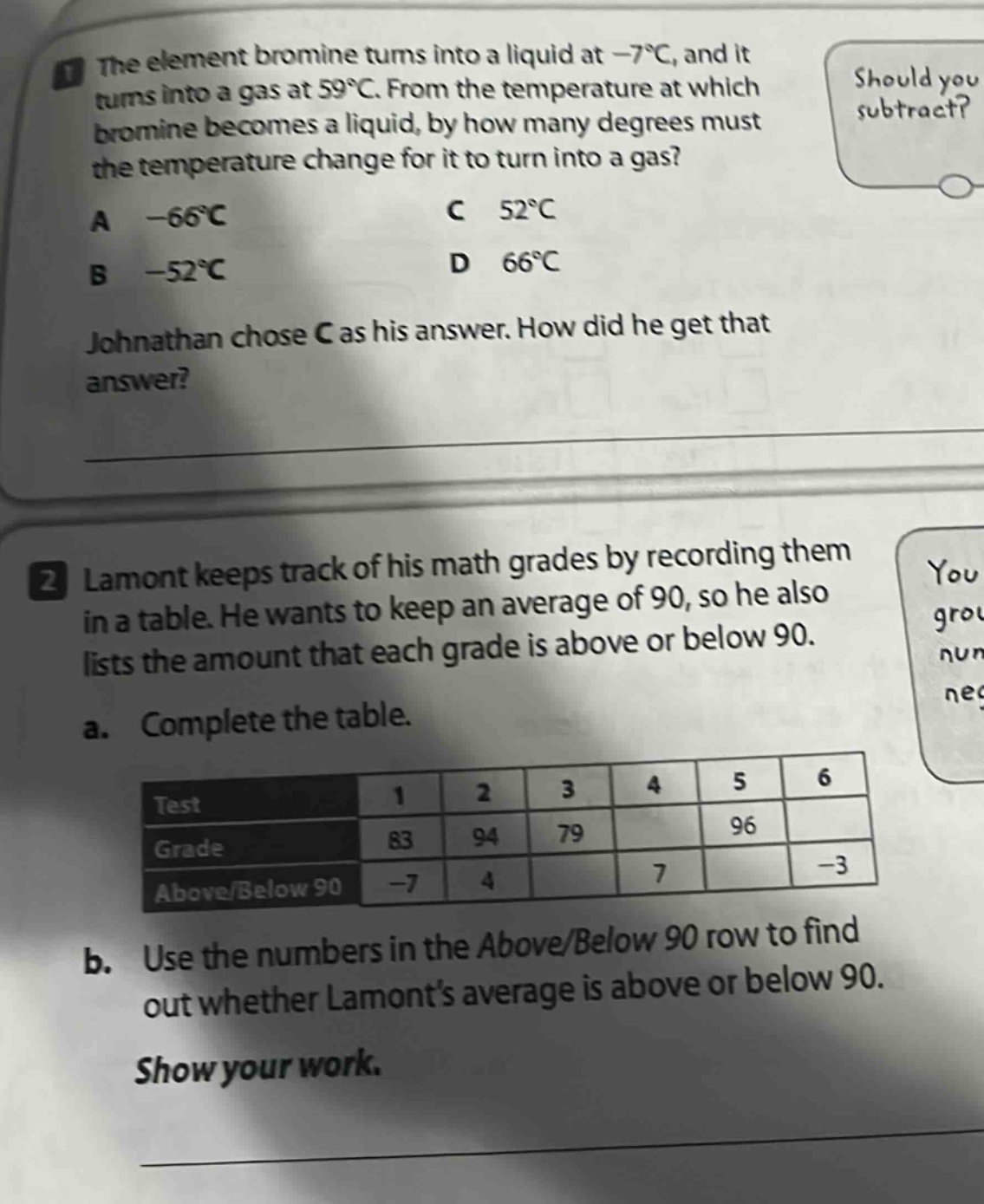
1. the element bromine turns into a liquid at -7°c, and it turns into a gas at 59°c. from the temperature at which bromine becomes a liquid, by how many degrees must the temperature change for it to turn into a gas? a -66°c c 52°c b -52°c d 66°c johnathan chose c as his answer. how did he get that answer? 2. lamont keeps track of his math grades by recording them in a table. he wants to keep an average of 90, so he also lists the amount that each grade is above or below 90. a. complete the table. test 1 2 3 4 5 6 grade 83 94 79 96 above/below 90 -7 4 7 -3 b. use the numbers in the above/below 90 row to find out whether lamonts average is above or below 90. show your work.
Answer
1. For the bromine - temperature problem
Explanation:
Step1: Identify the initial and final temperatures
Initial temperature (liquid state) $T_1=- 7^{\circ}C$, final temperature (gas state) $T_2 = 59^{\circ}C$.
Step2: Calculate the temperature change
We use the formula $\Delta T=T_2 - T_1$. Substitute the values: $\Delta T=59-(-7)=59 + 7=66^{\circ}C$.
Answer:
D. $66^{\circ}C$
Jonathan likely made a mistake by subtracting incorrectly. He probably did $59 - 7=52^{\circ}C$, forgetting that subtracting a negative number is equivalent to adding its positive counterpart.
2. For Lamont's math - grades problem
a. Completing the table
For test 3: Grade is 79, so above/below 90 is $79 - 90=-11$. For test 4: If above/below 90 is 7, then the grade is $90 + 7 = 97$. For test 5: Grade is 96, so above/below 90 is $96 - 90 = 6$. For test 6: If above/below 90 is - 3, then the grade is $90-3 = 87$. The completed table:
| Test | 1 | 2 | 3 | 4 | 5 | 6 |
|---|---|---|---|---|---|---|
| Grade | 83 | 94 | 79 | 97 | 96 | 87 |
| Above/Below 90 | -7 | 4 | -11 | 7 | 6 | -3 |
b. Finding the average deviation from 90
Explanation:
Step1: Sum up the values in the "Above/Below 90" row
Sum $S=-7 + 4-11 + 7+6-3$.
Step2: Calculate the sum
$S=(-7 + 4)+(-11 + 7)+(6-3)=-3-4 + 3=-4$. Since the sum of the deviations from 90 is - 4, Lamont's average is below 90.
Answer:
a. See the completed table above. b. Lamont's average is below 90. Work: $S=-7 + 4-11 + 7+6-3=-4$.