examine the following diagrams. columns i and ii contain rock layers a, b, c and d, e, f. both columns were…
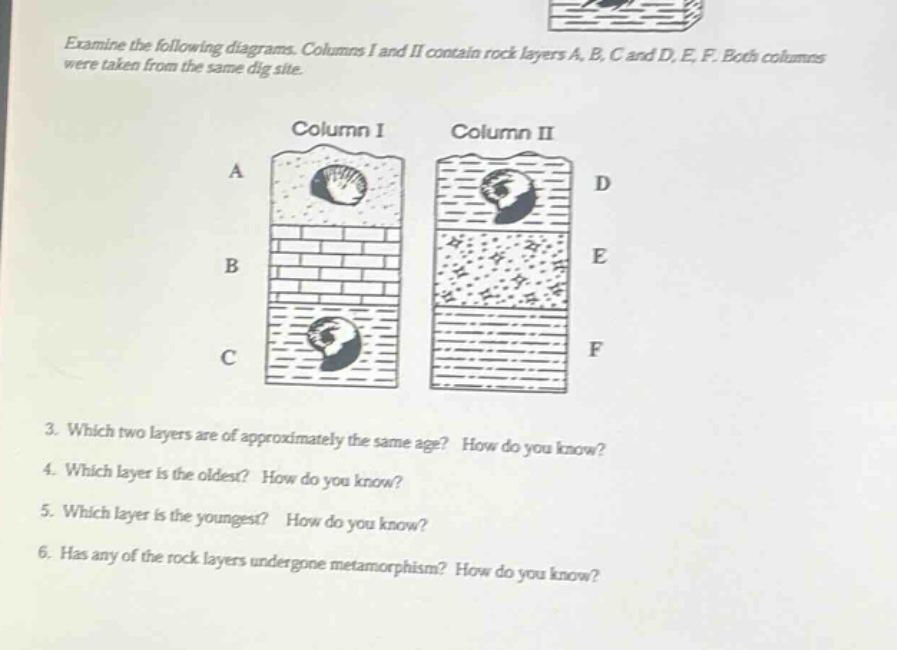
examine the following diagrams. columns i and ii contain rock layers a, b, c and d, e, f. both columns were taken from the same dig site. 3. which two layers are of approximately the same age? how do you know? 4. which layer is the oldest? how do you know? 5. which layer is the youngest? how do you know? 6. has any of the rock layers undergone metamorphism? how do you know?
Answer
Explanation:
Step1: Determine age - same fossils
Fossils in layers A and D are similar. Fossils can be used to date rock layers. Similar fossils imply similar age. So layers A and D are approximately the same age.
Step2: Determine oldest layer
The principle of superposition states that in undisturbed sedimentary rock layers, the oldest is at the bottom. In both columns, layer F and layer C are at the bottom. Since they are from the same dig - site and considering the overall context, layer F (or C if we consider them equivalent in the context of the whole site) is the oldest as it is the deepest layer.
Step3: Determine youngest layer
Using the principle of superposition again, the youngest layer is at the top. In column I, it is layer A and in column II, it is layer D. Since A and D are of similar age and at the top of their respective columns, they are the youngest.
Step4: Check for metamorphism
There are no visible signs such as recrystallization, foliation, or new mineral formation that are characteristic of metamorphic rocks in the diagrams. So, no rock layers have undergone metamorphism.
Answer:
- Layers A and D are of approximately the same age because they contain similar fossils.
- Layer F (or C considering the whole - site context) is the oldest because of the principle of superposition (oldest layers are at the bottom in undisturbed sedimentary sequences).
- Layers A and D are the youngest because of the principle of superposition (youngest layers are at the top in undisturbed sedimentary sequences).
- No, because there are no visible signs of recrystallization, foliation, or new mineral formation characteristic of metamorphic rocks.