exploration 2 the relative age of a rock layer describes whether it is older or younger than another layer…
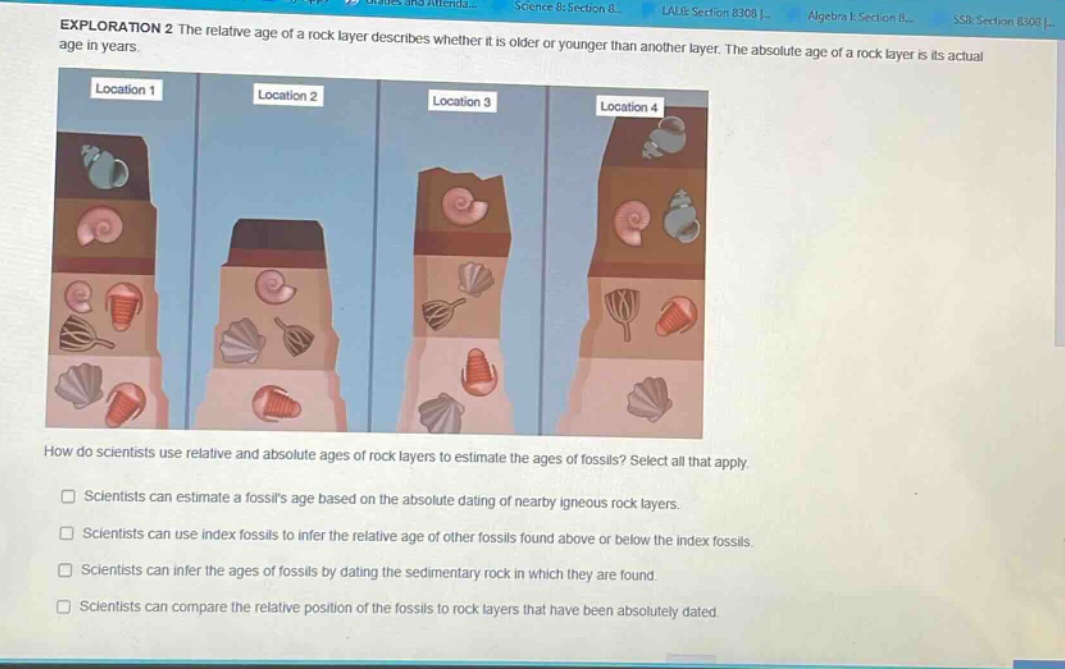
exploration 2 the relative age of a rock layer describes whether it is older or younger than another layer. the absolute age of a rock layer is its actual age in years. how do scientists use relative and absolute ages of rock layers to estimate the ages of fossils? select all that apply. scientists can estimate a fossils age based on the absolute dating of nearby igneous rock layers. scientists can use index fossils to infer the relative age of other fossils found above or below the index fossils. scientists can infer the ages of fossils by dating the sedimentary rock in which they are found. scientists can compare the relative position of the fossils to rock layers that have been absolutely dated.
Answer
Answer:
- Scientists can estimate a fossil's age based on the absolute dating of nearby igneous rock layers.
- Scientists can use index fossils to infer the relative age of other fossils found above or below the index fossils.
- Scientists can infer the ages of fossils by dating the sedimentary rock in which they are found.
- Scientists can compare the relative position of the fossils to rock layers that have been absolutely dated.
Explanation:
Step1: Understand absolute dating
Igneous rock layers can be dated absolutely using radiometric - dating techniques. Fossils near these layers can have their ages estimated.
Step2: Understand index fossils
Index fossils are from organisms that lived for a short, well - defined time. They help infer relative ages of other fossils in relation to them.
Step3: Understand sedimentary rock dating
Sedimentary rocks often contain fossils. Dating the sedimentary rock gives an estimate of the fossil's age.
Step4: Understand relative - position comparison
If rock layers are absolutely dated, the relative position of fossils within the rock column can help determine their ages.