9. which of the following is an example of simple random sampling?\na. surveying every 5th person who enters…
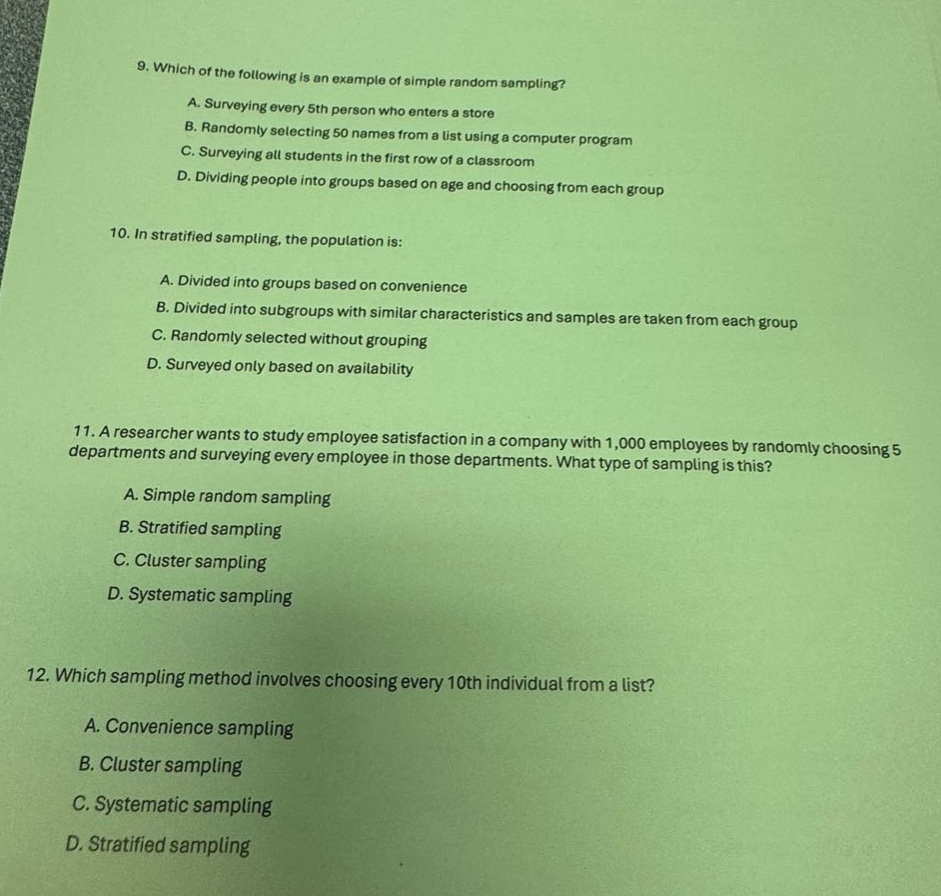
9. which of the following is an example of simple random sampling?\na. surveying every 5th person who enters a store\nb. randomly selecting 50 names from a list using a computer program\nc. surveying all students in the first row of a classroom\nd. dividing people into groups based on age and choosing from each group\n10. in stratified sampling, the population is:\na. divided into groups based on convenience\nb. divided into subgroups with similar characteristics and samples are taken from each group\nc. randomly selected without grouping\nd. surveyed only based on availability\n11. a researcher wants to study employee satisfaction in a company with 1,000 employees by randomly choosing 5 departments and surveying every employee in those departments. what type of sampling is this?\na. simple random sampling\nb. stratified sampling\nc. cluster sampling\nd. systematic sampling\n12. which sampling method involves choosing every 10th individual from a list?\na. convenience sampling\nb. cluster sampling\nc. systematic sampling\nd. stratified sampling
Answer
Brief Explanations:
- For question 9, simple random sampling involves randomly selecting elements from the population. Option B randomly selects 50 names from a list using a computer program which fits the definition. Option A is systematic sampling, Option C is convenience sampling, and Option D is stratified sampling.
- For question 10, in stratified sampling, the population is divided into subgroups (strata) with similar characteristics and samples are taken from each group.
- For question 11, cluster sampling involves dividing the population into clusters and randomly selecting some clusters and including all elements in the selected clusters. Here, departments are clusters.
- For question 12, choosing every 10th individual from a list is systematic sampling.
Answer:
- B. Randomly selecting 50 names from a list using a computer program
- B. Divided into subgroups with similar characteristics and samples are taken from each group
- C. Cluster sampling
- C. Systematic sampling