the function $f(x)=e^{x}$, when graphed, could be described as: increasing. decreasing. constant. none of…
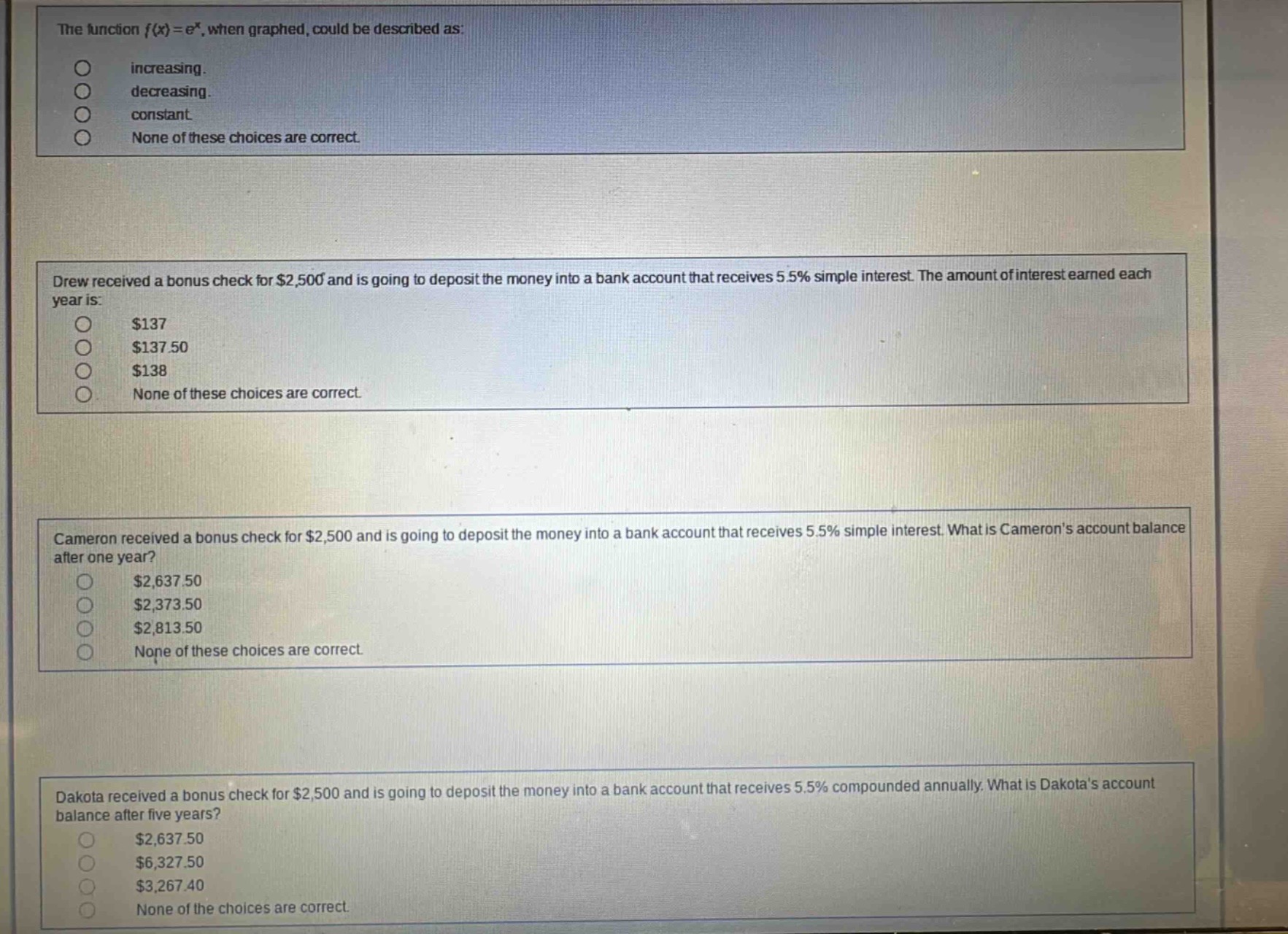
the function $f(x)=e^{x}$, when graphed, could be described as: increasing. decreasing. constant. none of these choices are correct. drew received a bonus check for $2,500 and is going to deposit the money into a bank account that receives 5.5% simple interest. the amount of interest earned each year is: $137 $137.50 $138 none of these choices are correct. cameron received a bonus check for $2,500 and is going to deposit the money into a bank account that receives 5.5% simple interest. what is camerons account balance after one year? $2,637.50 $2,373.50 $2,813.50 none of these choices are correct. dakota received a bonus check for $2,500 and is going to deposit the money into a bank account that receives 5.5% compounded annually. what is dakotas account balance after five years? $2,637.50 $6,327.50 $3,267.40 none of the choices are correct.
Answer
1. Análisis de la función $f(x)=e^{x}$
Explanation:
Step1: Encontrar la derivada
La derivada de $y = e^{x}$ es $y'=e^{x}$.
Step2: Analizar el signo de la derivada
Como $e^{x}>0$ para todo $x\in R$, la función es creciente.
Answer:
increasing
2. Cálculo del interés simple anual
Explanation:
Step1: Usar la fórmula de interés simple
La fórmula de interés simple es $I = Prt$, donde $P$ es el principal, $r$ es la tasa de interés y $t$ es el tiempo. Aquí, $P = 2500$, $r=0.055$ y $t = 1$.
Step2: Calcular el interés
$I=2500\times0.055\times1=137.5$
Answer:
$137.50$
3. Cálculo del saldo de la cuenta con interés simple después de un año
Explanation:
Step1: Usar la fórmula del saldo con interés simple
El saldo $A$ con interés simple se calcula como $A=P + I$, donde $P$ es el principal y $I$ es el interés. Sabemos que $P = 2500$ y $I=137.5$ (calculado anteriormente).
Step2: Calcular el saldo
$A=2500 + 137.5=2637.5$
Answer:
$2,637.50$
4. Cálculo del saldo de la cuenta con interés compuesto después de cinco años
Explanation:
Step1: Usar la fórmula de interés compuesto
La fórmula de interés compuesto es $A=P(1 + r)^{t}$, donde $P = 2500$, $r = 0.055$ y $t=5$.
Step2: Calcular $(1 + r)^{t}$
$(1 + 0.055)^{5}=1.055^{5}\approx1.30696$
Step3: Calcular el saldo
$A=2500\times1.30696 = 3267.4$
Answer:
$3,267.40$