7) generally speaking, the amount of gun powder particles found around a bullet hole is ______ to the…
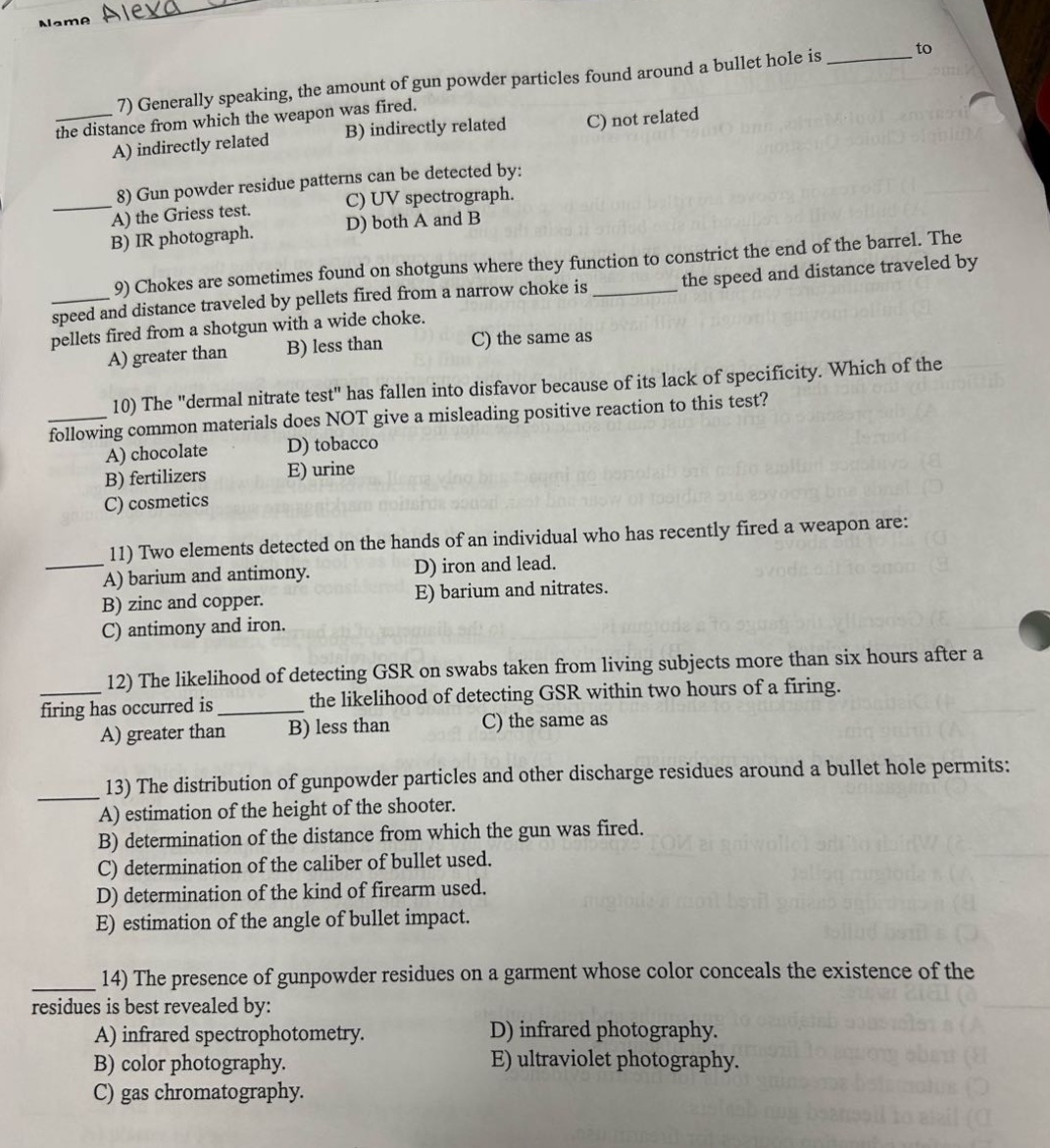
7) generally speaking, the amount of gun powder particles found around a bullet hole is ______ to the distance from which the weapon was fired.\na) directly related b) indirectly related c) not related\n8) gun powder residue patterns can be detected by:\na) the griess test. b) ir photograph. c) uv spectrograph. d) both a and b\n9) chokes are sometimes found on shotguns where they function to constrict the end of the barrel. the speed and distance traveled by pellets fired from a narrow choke is ______ the speed and distance traveled by pellets fired from a shotgun with a wide choke.\na) greater than b) less than c) the same as\n10) the \dermal nitrate test\ has fallen into disfavor because of its lack of specificity. which of the following common materials does not give a misleading positive reaction to this test?\na) chocolate b) fertilizers c) cosmetics d) tobacco e) urine\n11) two elements detected on the hands of an individual who has recently fired a weapon are:\na) barium and antimony. b) zinc and copper. c) antimony and iron. d) iron and lead. e) barium and nitrates.\n12) the likelihood of detecting gsr on swabs taken from living subjects more than six hours after a firing has occurred is ______ the likelihood of detecting gsr within two hours of a firing.\na) greater than b) less than c) the same as\n13) the distribution of gunpowder particles and other discharge residues around a bullet hole permits:\na) estimation of the height of the shooter.\nb) determination of the distance from which the gun was fired.\nc) determination of the caliber of bullet used.\nd) determination of the kind of firearm used.\ne) estimation of the angle of bullet impact.\n14) the presence of gunpowder residues on a garment whose color conceals the existence of the residues is best revealed by:\na) infrared spectrophotometry. b) color photography. c) gas chromatography. d) infrared photography. e) ultraviolet photography.
Answer
Brief Explanations:
- As the distance from which the weapon is fired increases, the amount of gun - powder particles around the bullet hole decreases, so it's indirectly related.
- Gun powder residue patterns can be detected by the Griess test (for nitrites) and IR photograph (due to characteristic absorption), and UV spectrograph can also be used for detection.
- A narrow choke constricts the barrel more, increasing the speed and distance of pellets compared to a wide choke.
- Urine does not typically give a misleading positive reaction to the dermal nitrate test while chocolate, fertilizers, and cosmetics can.
- Barium and antimony are two elements commonly detected on the hands of a person who has recently fired a weapon.
- The likelihood of detecting GSR (gun - shot residue) on swabs from living subjects more than six hours after firing is less than within two hours as the residue may be lost or degraded over time.
- The distribution of gunpowder particles and other discharge residues around a bullet hole can be used to determine the distance from which the gun was fired.
- Infrared photography can reveal gunpowder residues on a garment even if the color conceals them as the residues may have different infrared absorption or reflection properties.
Answer:
- B) indirectly related
- D) both A and B
- A) greater than
- E) urine
- A) barium and antimony
- B) less than
- B) determination of the distance from which the gun was fired
- D) infrared photography