graded quiz: basics of earth science 0:06:25 elapsed mohs hardness scale mineral name scale number common…
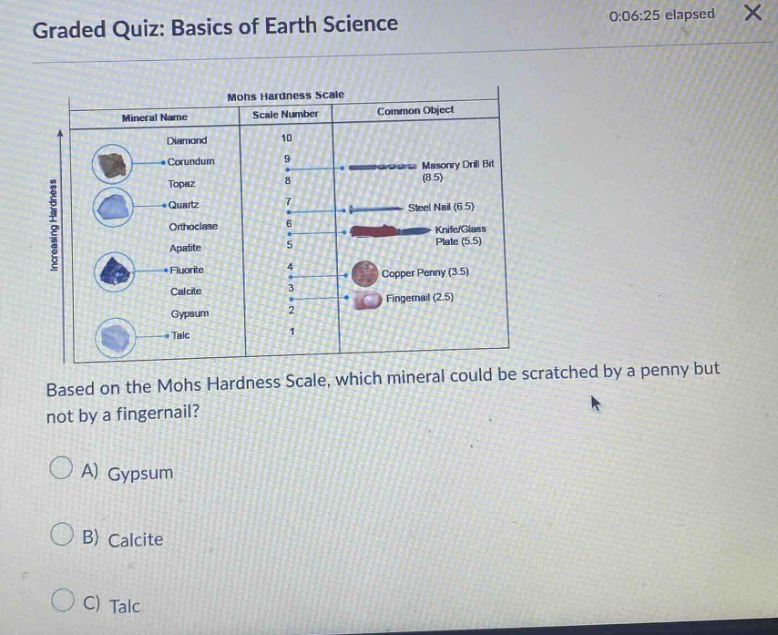
graded quiz: basics of earth science 0:06:25 elapsed mohs hardness scale mineral name scale number common object diamond 10 masonry drill bit (8.5) corundum 9 topaz 8 quartz 7 steel nail (6.5) orthoclase 6 knife/glass plate (5.5) apatite 5 fluorite 4 copper penny (3.5) calcite 3 fingernail (2.5) gypsum 2 talc 1 based on the mohs hardness scale, which mineral could be scratched by a penny but not by a fingernail? a) gypsum b) calcite c) talc
Answer
Answer:
B. Calcite
Explanation:
Step1: Identify penny and fingernail hardness
A copper - penny has a hardness of 3.5 and a fingernail has a hardness of 2.5 on the Mohs Hardness Scale.
Step2: Analyze each option
Gypsum has a hardness of 2, so it can be scratched by a fingernail. Talc has a hardness of 1, so it can also be scratched by a fingernail. Calcite has a hardness of 3. It cannot be scratched by a fingernail (2.5) but can be scratched by a penny (3.5).