1. the half - life of a radioactive element, such as carbon - 14, is the time it takes for half of the atoms…
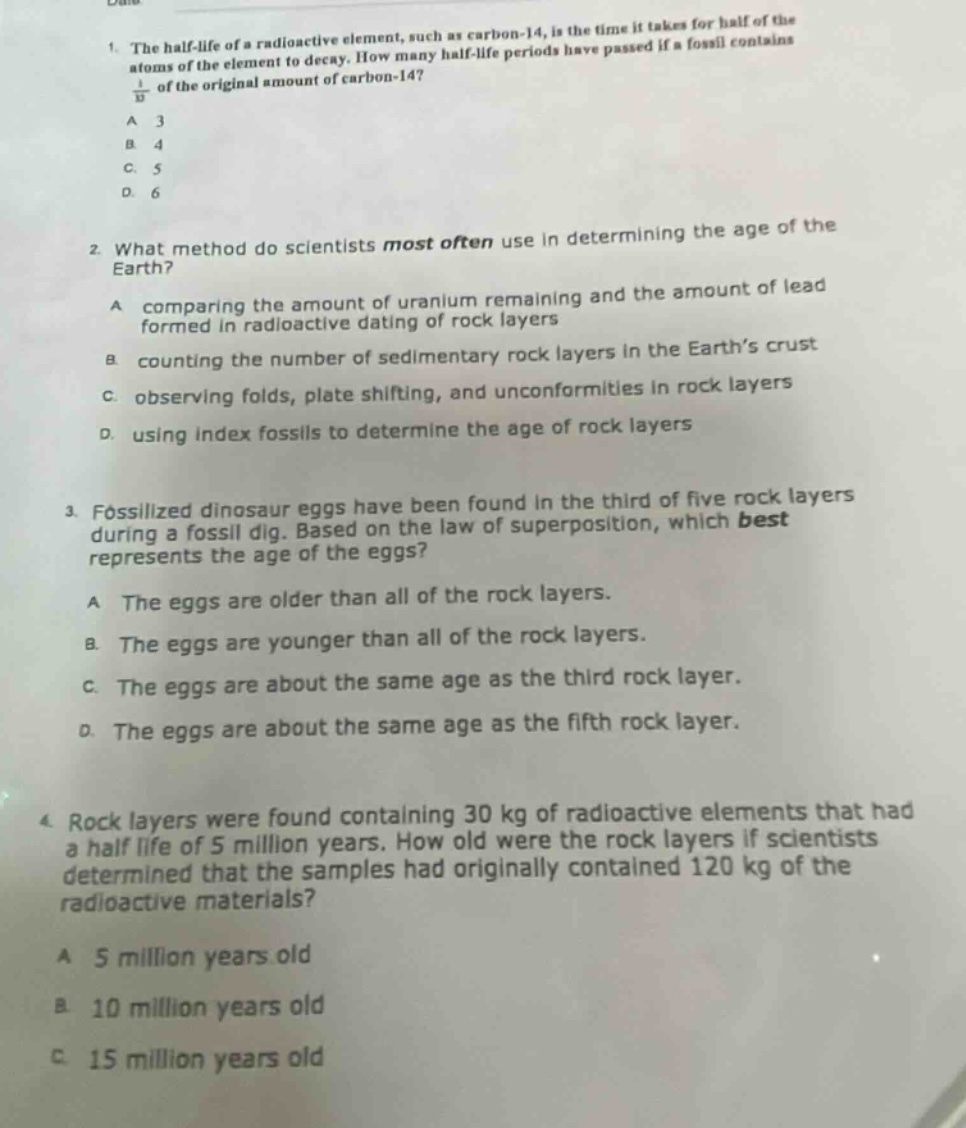
1. the half - life of a radioactive element, such as carbon - 14, is the time it takes for half of the atoms of the element to decay. how many half - life periods have passed if a fossil contains 1/32 of the original amount of carbon - 14?\na 3\nb 4\nc 5\nd 6\n\n2. what method do scientists most often use in determining the age of the earth?\na comparing the amount of uranium remaining and the amount of lead formed in radioactive dating of rock layers\nb counting the number of sedimentary rock layers in the earth’s crust\nc observing folds, plate shifting, and unconformities in rock layers\nd using index fossils to determine the age of rock layers\n\n3. fossilized dinosaur eggs have been found in the third of five rock layers during a fossil dig. based on the law of superposition, which best represents the age of the eggs?\na the eggs are older than all of the rock layers.\nb the eggs are younger than all of the rock layers.\nc the eggs are about the same age as the third rock layer.\nd the eggs are about the same age as the fifth rock layer.\n\n4. rock layers were found containing 30 kg of radioactive elements that had a half life of 5 million years. how old were the rock layers if scientists determined that the samples had originally contained 120 kg of the radioactive materials?\na 5 million years old\nb 10 million years old\nc 15 million years old
Answer
Explanation:
Step1: Recall half - life formula
The amount of a radioactive substance $N$ after $n$ half - life periods is given by $N = N_0\times(\frac{1}{2})^n$, where $N_0$ is the initial amount.
Step2: Solve for $n$ in the first question
We are given $N=\frac{1}{32}N_0$. Substituting into the formula $\frac{1}{32}N_0=N_0\times(\frac{1}{2})^n$. Canceling out $N_0$ (since $N_0\neq0$), we get $\frac{1}{32}=(\frac{1}{2})^n$. Since $\frac{1}{32}=\frac{1}{2^5}$, then $n = 5$.
Step3: Answer the second question
Scientists most often use radioactive dating by comparing the amount of uranium remaining and the amount of lead formed in rock layers to determine the age of the Earth. So the answer is A.
Step4: Answer the third question
According to the law of superposition, fossils are the same age as the rock layer in which they are found. So if dinosaur eggs are in the third rock layer, they are about the same age as the third rock layer. The answer is C.
Step5: Solve for the age in the fourth question
The initial amount $N_0 = 120$ kg and the current amount $N = 30$ kg. Using $N = N_0\times(\frac{1}{2})^n$, we substitute the values: $30=120\times(\frac{1}{2})^n$. First, simplify to $\frac{30}{120}=(\frac{1}{2})^n$, so $\frac{1}{4}=(\frac{1}{2})^n$. Since $\frac{1}{4}=\frac{1}{2^2}$, $n = 2$. The half - life is 5 million years, so the age of the rock layers is $2\times5=10$ million years. The answer is B.
Answer:
- C
- A
- C
- B