the horsepower (hp) that a shaft can safely transmit varies jointly with its speed (in revolutions per…
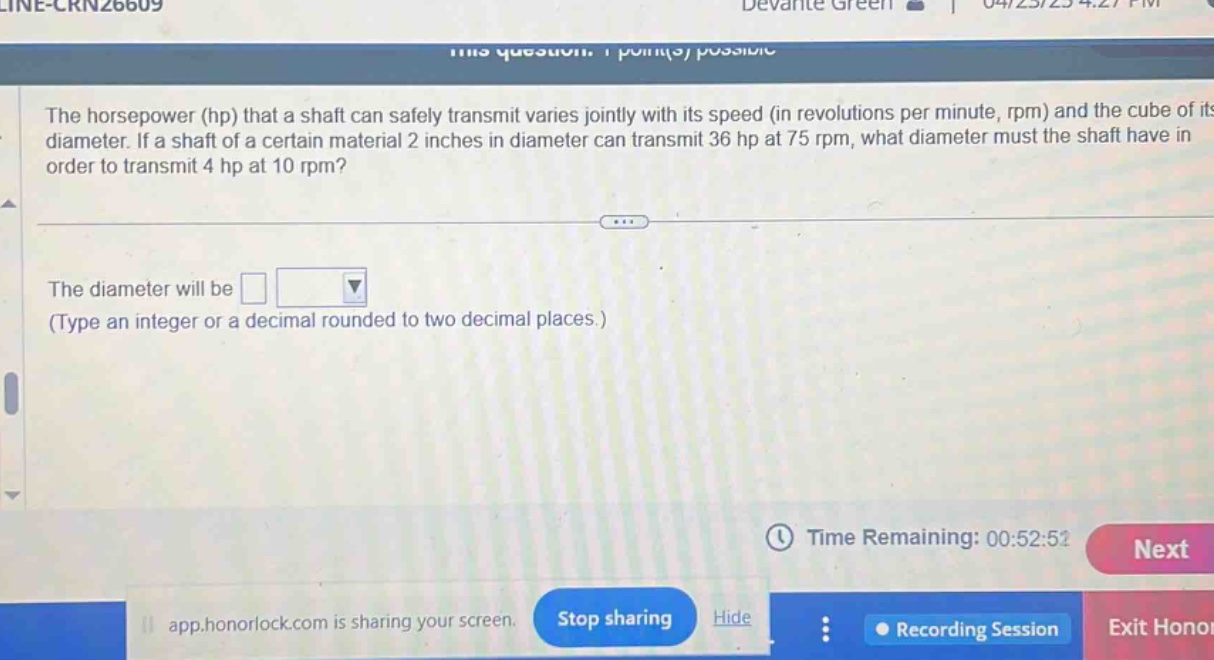
the horsepower (hp) that a shaft can safely transmit varies jointly with its speed (in revolutions per minute, rpm) and the cube of its diameter. if a shaft of a certain material 2 inches in diameter can transmit 36 hp at 75 rpm, what diameter must the shaft have in order to transmit 4 hp at 10 rpm?\nthe diameter will be \n(type an integer or a decimal rounded to two decimal places.)
Answer
Explanation:
Step1: Write the joint - variation formula
Let $H$ be the horsepower, $s$ be the speed, and $d$ be the diameter. The joint - variation formula is $H = ksd^{3}$, where $k$ is the constant of variation. We know that when $H = 36$, $s = 75$, and $d = 2$. Substitute these values into the formula: $36=k\times75\times2^{3}$
Step2: Solve for the constant of variation $k$
First, calculate $2^{3}=8$. Then the equation becomes $36 = k\times75\times8$. $36=600k$. Solve for $k$: $k=\frac{36}{600}=0.06$.
Step3: Use the value of $k$ to find the new diameter
We want to find $d$ when $H = 4$ and $s = 10$. Substitute $k = 0.06$, $H = 4$, and $s = 10$ into the formula $H = ksd^{3}$. $4=0.06\times10\times d^{3}$ $4 = 0.6d^{3}$
Step4: Solve for $d$
First, divide both sides of the equation by $0.6$: $d^{3}=\frac{4}{0.6}=\frac{40}{6}=\frac{20}{3}\approx6.67$ Then, take the cube - root of both sides: $d=\sqrt[3]{\frac{20}{3}}\approx1.88$
Answer:
$1.88$