humans have only been on earth for only 200,000 years, so there is no written or visual record of what time…
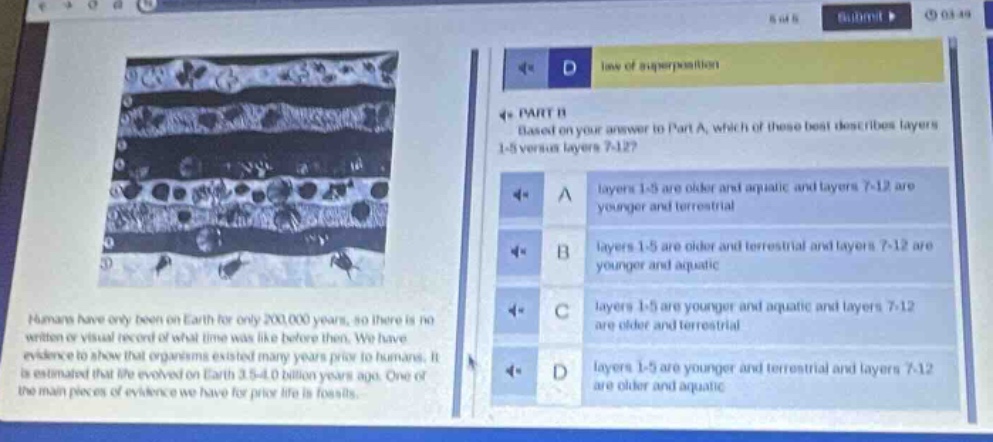
humans have only been on earth for only 200,000 years, so there is no written or visual record of what time was like before then. we have evidence to show that organisms existed many years prior to humans. it is estimated that life evolved on earth 3.5 - 4.0 billion years ago. one of the main pieces of evidence we have for prior life is fossils. part ii based on your answer to part a, which of these best describes layers 1 - 5 versus layers 7 - 12? a layers 1 - 5 are older and aquatic and layers 7 - 12 are younger and terrestrial b layers 1 - 5 are older and terrestrial and layers 7 - 12 are younger and aquatic c layers 1 - 5 are younger and aquatic and layers 7 - 12 are older and terrestrial d layers 1 - 5 are younger and terrestrial and layers 7 - 12 are older and aquatic
Answer
Brief Explanation:
According to the law of superposition, in undisturbed sedimentary rock layers, the lower layers are older and the upper - layers are younger. Typically, different types of fossils can indicate whether the environment was aquatic or terrestrial. Assuming a normal sedimentary sequence, the lower layers (1 - 5) are older. If there are aquatic fossils in lower layers and terrestrial fossils in upper layers, it implies that the lower layers are older and aquatic and the upper layers (7 - 12) are younger and terrestrial.
Answer:
A. layers 1 - 5 are older and aquatic and layers 7 - 12 are younger and terrestrial