identify i1\nr1 4ω\nr3 24ω\nvs 6v\nr2 12ω\n2.25mw\n2.25ω\n500mv\n150ma\n500mw\n2.25mv\n2.25ma\n150mv\n150ω\n5…
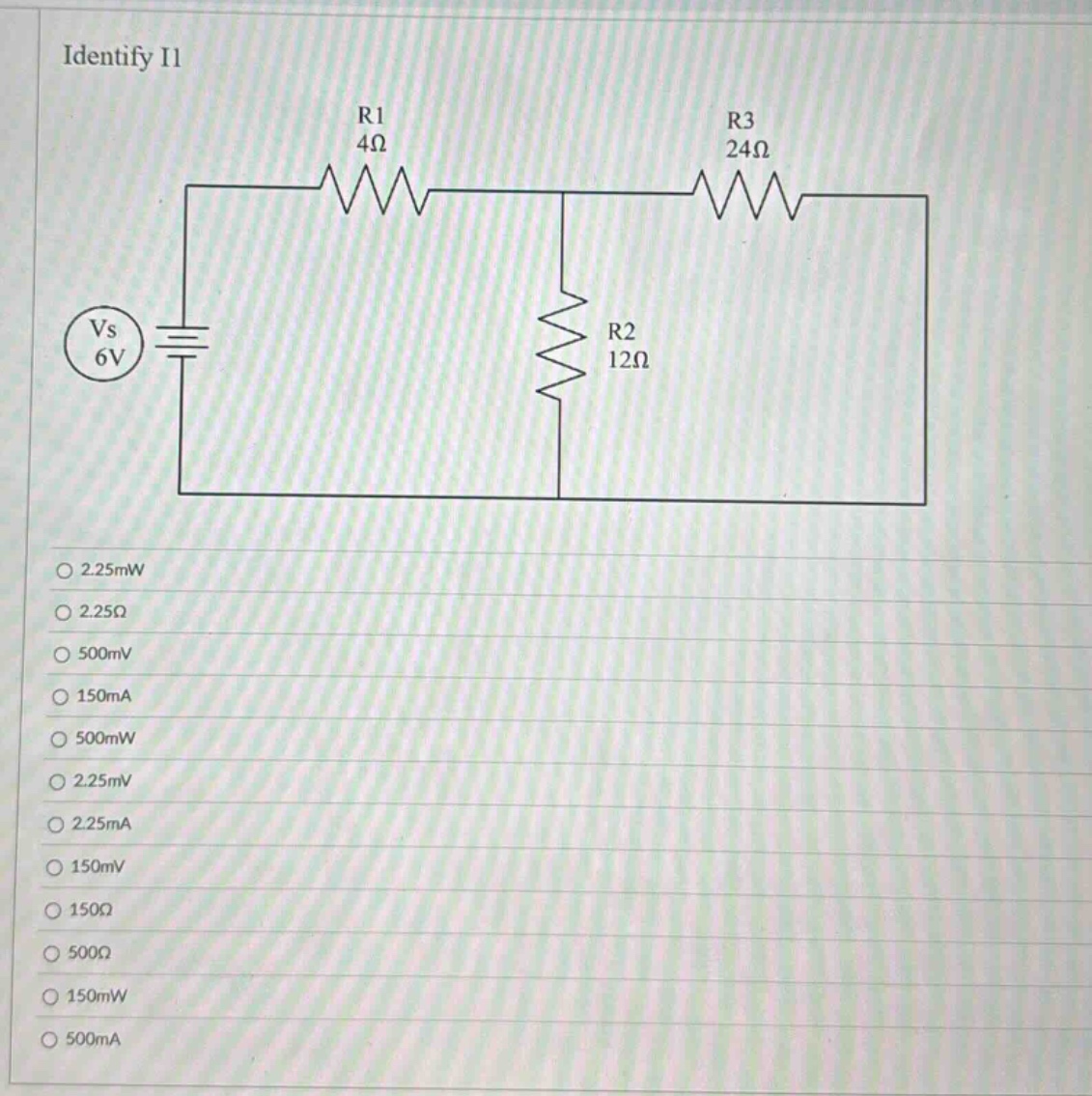
identify i1\nr1 4ω\nr3 24ω\nvs 6v\nr2 12ω\n2.25mw\n2.25ω\n500mv\n150ma\n500mw\n2.25mv\n2.25ma\n150mv\n150ω\n500ω\n150mw\n500ma
Answer
Explanation:
Step1: Calculate the equivalent resistance of R2 and R3 in parallel
The formula for parallel - resistance is $R_{eq1}=\frac{R2\times R3}{R2 + R3}$. Substituting $R2 = 12\Omega$ and $R3=24\Omega$, we get $R_{eq1}=\frac{12\times24}{12 + 24}=\frac{288}{36}=8\Omega$.
Step2: Calculate the total equivalent resistance of the circuit
$R_{total}=R1+R_{eq1}$. Given $R1 = 4\Omega$ and $R_{eq1}=8\Omega$, then $R_{total}=4 + 8=12\Omega$.
Step3: Calculate the total current in the circuit using Ohm's law ($I=\frac{V}{R}$)
Given $V = 6V$ and $R_{total}=12\Omega$, the total current $I=\frac{6}{12}=0.5A = 500mA$.
Step4: Calculate the voltage across R2 and R3
The voltage across R2 and R3 is $V_{23}=I\times R_{eq1}=0.5\times8 = 4V$.
Step5: Calculate the current through R2
Using Ohm's law for R2, $I1=\frac{V_{23}}{R2}$. Substituting $V_{23}=4V$ and $R2 = 12\Omega$, we get $I1=\frac{4}{12}=\frac{1}{3}A\approx333.33mA$. This is wrong. Let's start over from step 3 in a different way. We know that the voltage across the parallel - combination of R2 and R3 is $V_{parallel}=V - I\times R1$. First, find the current in the circuit using the fact that the voltage across the parallel part and the voltage drop across R1 sum up to the source voltage. Let the current through the circuit be $I$. The voltage across the parallel part $V_p$ and across R1 is $V_1$. So $V = V_1+V_p$. Also, $V_1 = I\times R1$ and $V_p=I\times R_{eq1}$. Since $V = 6V$, $R1 = 4\Omega$ and $R_{eq1}=8\Omega$. The current in the circuit $I=\frac{V}{R1 + R_{eq1}}=\frac{6}{4 + 8}=0.5A$. The voltage across R2 (and R3 in parallel) is $V_{R2}=V - I\times R1=6-0.5\times4=4V$. The current through R2, $I1=\frac{V_{R2}}{R2}=\frac{4}{12}=\frac{1}{3}A\approx333.33mA$. There is a mistake above. Let's use the current - division rule. The total current in the circuit $I=\frac{V}{R1+\frac{R2\times R3}{R2 + R3}}=\frac{6}{4+\frac{12\times24}{12 + 24}}=\frac{6}{4 + 8}=0.5A$. The current through R2 using the current - division rule: The current through the parallel - branch is $I_{parallel}=\frac{V}{ \frac{R2\times R3}{R2 + R3}}$. And by the current - division rule, the current through R2, $I1=\frac{R3}{R2 + R3}\times I_{total}$. The total current $I_{total}=\frac{V}{R1+\frac{R2\times R3}{R2 + R3}}=\frac{6}{4 + 8}=0.5A$. $I1=\frac{R3}{R2+R3}\times I_{total}=\frac{24}{12 + 24}\times0.5=\frac{24}{36}\times0.5=\frac{1}{3}A\approx333.33mA$. If we assume the question is asking for the current through R2: The voltage across the parallel part of R2 and R3 is $V_{parallel}=V\times\frac{\frac{R2\times R3}{R2 + R3}}{R1+\frac{R2\times R3}{R2 + R3}}=6\times\frac{8}{4 + 8}=4V$. The current through R2, $I1=\frac{V_{parallel}}{R2}=\frac{4}{12}=\frac{1}{3}A = 333.33mA$. But if we assume the question is asking for the current through R1: The total resistance of the circuit $R_{total}=R1+\frac{R2\times R3}{R2 + R3}=4 + 8=12\Omega$. Using Ohm's law $I=\frac{V}{R}$, where $V = 6V$ and $R = 12\Omega$, the current through R1 (which is the total current in the circuit) is $I=\frac{6}{12}=0.5A=500mA$.
Answer:
500mA