identify the type of wave: surface wave, s - wave, p - wave, tsunami\narrives first at seismic stations…
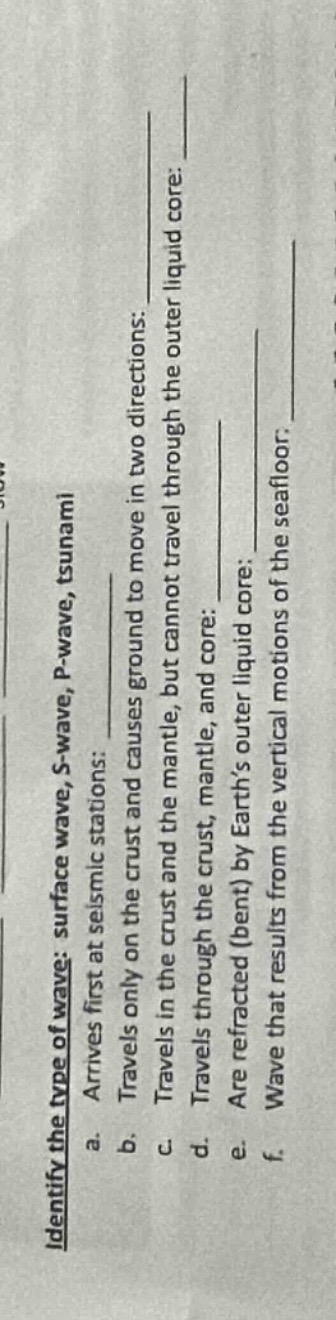
identify the type of wave: surface wave, s - wave, p - wave, tsunami\narrives first at seismic stations: a.\ntravels only on the crust and causes ground to move in two directions: b.\ntravels in the crust and the mantle but cannot travel through the outer liquid core: c.\ntravels through the crust, mantle, and core: d.\ntravels by earths outer liquid core (bent) refracted: e.\nare wave that results from the vertical motions of the seafloor: f.
Answer
Answer:
a. P - wave
Explanation:
Step1: Recall seismic - wave properties
P - waves arrive first at seismic stations.
Step2: Analyze wave - travel characteristics
P - waves can travel through solids, liquids, and gases. S - waves can only travel through solids. Since P - waves can travel through the liquid outer core while S - waves cannot, and P - waves arrive first at seismic stations, the wave that arrives first at seismic stations and travels on the crust and causes ground to move in two directions is the P - wave.