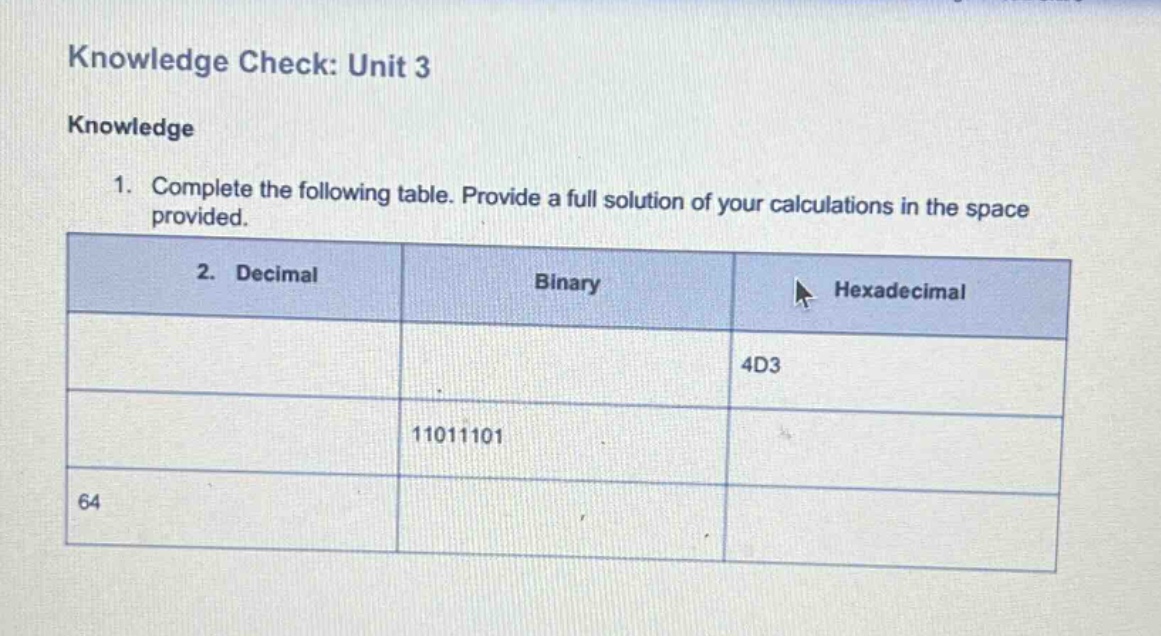
knowledge check: unit 3\nknowledge\n1. complete the following table. provide a full solution of your…
knowledge check: unit 3\nknowledge\n1. complete the following table. provide a full solution of your calculations in the space provided.\n| decimal | binary | hexadecimal |\n| ---- | ---- | ---- |\n| | | 4d3 |\n| | 11011101 | |\n| 64 | | |
Answer
Explanation:
Step1: Convert hexadecimal 4D3 to decimal and binary
Decimal:
In hexadecimal, each digit represents a power of 16. For 4D3, we have (4\times16^{2}+13\times16^{1}+3\times16^{0}) (since D = 13 in decimal).
Binary: First convert each hex - digit to 4 - bit binary. 4 is 0100 in binary, D (13) is 1101 in binary, 3 is 0011 in binary. So 4D3 in hexadecimal is 010011010011 in binary.
Step2: Convert binary 11011101 to decimal and hexadecimal
Hexadecimal: Group the binary digits into groups of 4 from right - to - left: 1101 1101. 1101 is D in hexadecimal. So 11011101 in binary is DD in hexadecimal.
Step3: Convert decimal 64 to binary and hexadecimal
Binary: Divide 64 by 2 successively. (64\div2 = 32) remainder 0, (32\div2=16) remainder 0, (16\div2 = 8) remainder 0, (8\div2=4) remainder 0, (4\div2 = 2) remainder 0, (2\div2=1) remainder 0, (1\div2 = 0) remainder 1. Reading the remainders from bottom - to - top, 64 in decimal is 1000000 in binary.
Hexadecimal: Divide 64 by 16. (64\div16 = 4) remainder 0. So 64 in decimal is 40 in hexadecimal.