the law of uniformitarianism states that the geological processes we observe today have occurred in the past…
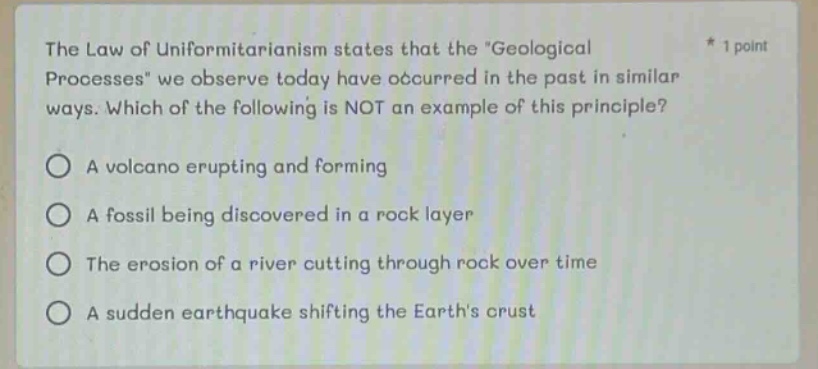
the law of uniformitarianism states that the geological processes we observe today have occurred in the past in similar ways. which of the following is not an example of this principle? a volcano erupting and forming a fossil being discovered in a rock layer the erosion of a river cutting through rock over time a sudden earthquake shifting the earths crust
Answer
Answer:
B. A fossil being discovered in a rock layer
Brief Explanation:
The Law of Uniformitarianism refers to ongoing geological - like processes. Discovering a fossil is an observation, not a geological process demonstrating the principle. Volcano eruptions, river erosion, and earthquakes are geological processes that have occurred in similar ways in the past and present.