1. list the rock layers from youngest to oldest relative ages. r,h,m,f,b,i 2. how does the rock layer h…
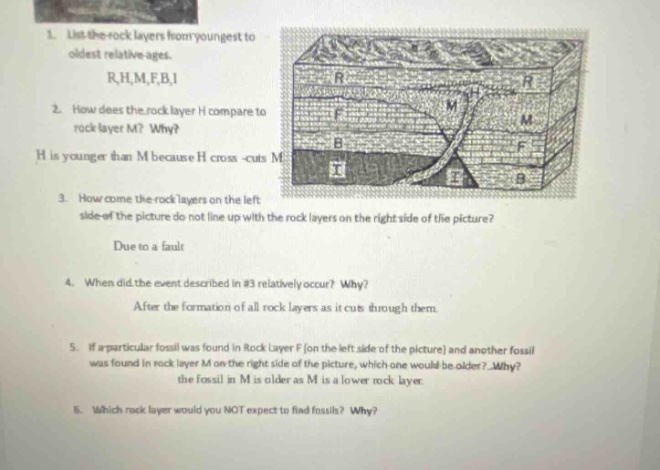
1. list the rock layers from youngest to oldest relative ages. r,h,m,f,b,i 2. how does the rock layer h compare to rock layer m? why? h is younger than m because h cross - cuts m 3. how come the rock layers on the left side of the picture do not line up with the rock layers on the right side of the picture? due to a fault 4. when did the event described in #3 relatively occur? why? after the formation of all rock layers as it cuts through them 5. if a particular fossil was found in rock layer f (on the left side of the picture) and another fossil was found in rock layer m (on the right side of the picture), which one would be older? why? the fossil in m is older as m is a lower rock layer 6. which rock layer would you not expect to find fossils? why?
Answer
Answer:
- R, H, M, F, B, I
- H is younger than M because H cross - cuts M.
- Due to a fault.
- After the formation of all rock layers as it cuts through them.
- The fossil in M is older as M is a lower rock layer.
- No answer provided in the given text.
Explanation:
Step1: Analyze rock layer order
Based on cross - cutting relationships and superposition.
Step2: Determine relative age of H and M
Cross - cutting rock is younger.
Step3: Identify cause of non - alignment
Faults can displace rock layers.
Step4: Date the fault event
Fault cuts through all layers, so occurs after layer formation.
Step5: Compare fossil ages
Lower rock layers are older generally.
Step6: No information for this question
No data given about fossil - bearing layers.