what are the measures of \\(\\overarc{jk}\\) and \\(\\angle kij\\)? measure of \\(\\overarc{jk} =…
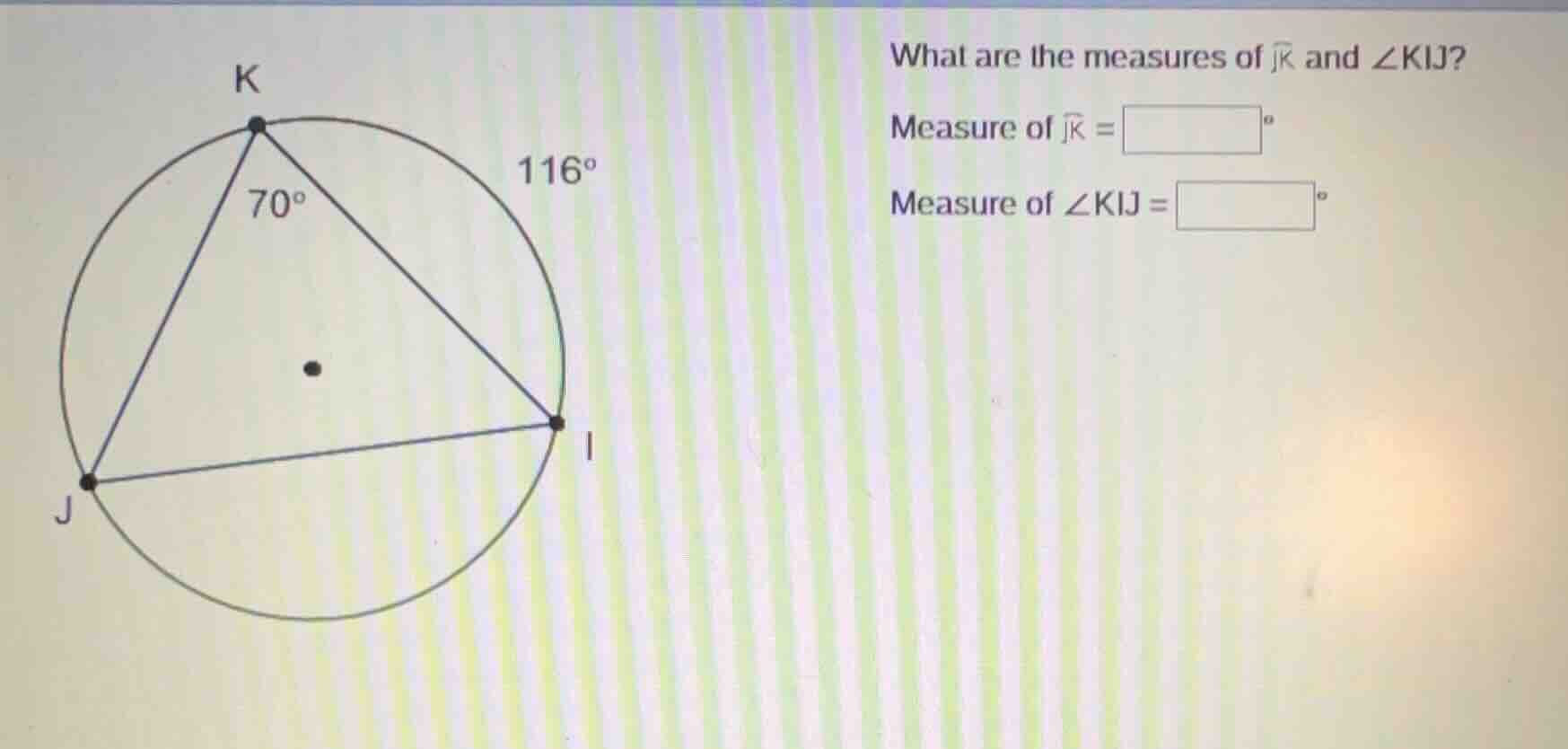
what are the measures of \\(\\overarc{jk}\\) and \\(\\angle kij\\)? measure of \\(\\overarc{jk} = \\square^\\circ\\) measure of \\(\\angle kij = \\square^\\circ\\) (with a circle diagram having points k, i, j, angle at k is 70°, arc from k to i is 116°)
Answer
Explanation:
Step1: Find measure of arc JK
The total degrees in a circle is ( 360^\circ ). We know one arc is ( 116^\circ ) and the inscribed angle ( \angle KJI ) is related, but first, recall that the measure of an inscribed angle is half the measure of its intercepted arc. Wait, actually, to find arc ( JK ), we can use the fact that the sum of arcs in a circle is ( 360^\circ ), but also, the inscribed angle ( \angle KIJ ) or wait, no, let's look at the given angle. Wait, the triangle at K has an angle of ( 70^\circ ), but maybe better to use the fact that the measure of an inscribed angle is half the intercepted arc. Wait, no, let's first find arc ( JK ). Wait, the arc ( KI ) is ( 116^\circ )? Wait, no, the diagram shows arc ( KI ) as ( 116^\circ )? Wait, no, the label is ( 116^\circ ) on the arc from K to I? Wait, maybe the circle has three arcs: arc JK, arc KI, and arc IJ? Wait, no, the points are J, K, I on the circle. So the arcs are JK, KI, and IJ. The sum of arcs in a circle is ( 360^\circ ). Wait, but we also know that the inscribed angle ( \angle KJI ) or ( \angle KIJ )? Wait, the angle at K is ( 70^\circ ), which is an inscribed angle? Wait, no, the angle at K is ( 70^\circ ), which is an inscribed angle intercepting arc IJ. Wait, the measure of an inscribed angle is half the measure of its intercepted arc. So if ( \angle K = 70^\circ ), then arc IJ is ( 2 \times 70^\circ = 140^\circ ). Then, we know arc KI is ( 116^\circ ) (from the diagram), so arc JK can be found by ( 360^\circ - arc IJ - arc KI ). Wait, ( 360 - 140 - 116 = 104^\circ )? Wait, no, that can't be. Wait, maybe I got the arcs wrong. Wait, let's re-examine. The points are J, K, I on the circle. So the arcs are JK, KI, and IJ. The angle at K is ( 70^\circ ), which is an inscribed angle intercepting arc IJ. So arc IJ = ( 2 \times 70^\circ = 140^\circ ). The arc KI is given as ( 116^\circ )? Wait, the diagram shows ( 116^\circ ) on the arc from K to I. Then arc JK = ( 360^\circ - arc IJ - arc KI = 360 - 140 - 116 = 104^\circ )? Wait, no, that seems off. Wait, maybe the ( 116^\circ ) is arc IJ? No, the label is near K and I. Wait, maybe the angle at K is ( 70^\circ ), which is an inscribed angle, so arc IJ is ( 140^\circ ), and arc KI is ( 116^\circ ), so arc JK is ( 360 - 140 - 116 = 104 )? Wait, but let's check the second part, the measure of ( \angle KIJ ). The measure of an inscribed angle is half the measure of its intercepted arc. So ( \angle KIJ ) intercepts arc JK. So if arc JK is ( 104^\circ ), then ( \angle KIJ = \frac{1}{2} \times 104^\circ = 52^\circ ). Wait, but let's verify. Alternatively, the sum of angles in a triangle is ( 180^\circ ). If ( \angle K = 70^\circ ), and ( \angle KIJ = x ), then ( \angle KJI = 180 - 70 - x = 110 - x ). But ( \angle KJI ) is an inscribed angle intercepting arc KI, which is ( 116^\circ ), so ( \angle KJI = \frac{1}{2} \times 116^\circ = 58^\circ ). Then, ( 180 - 70 - 58 = 52^\circ ), so ( \angle KIJ = 52^\circ ). Then, arc JK is intercepted by ( \angle KIJ ), so arc JK = ( 2 \times 52^\circ = 104^\circ ). Yes, that makes sense. So:
Step1: Find arc JK
First, find ( \angle KJI ), which is an inscribed angle intercepting arc KI (116°). So ( \angle KJI = \frac{1}{2} \times 116^\circ = 58^\circ ).
Step2: Find ( \angle KIJ )
In triangle KIJ, sum of angles is 180°. So ( \angle KIJ = 180^\circ - 70^\circ - 58^\circ = 52^\circ ).
Step3: Find arc JK
( \angle KIJ ) is an inscribed angle intercepting arc JK, so arc JK = ( 2 \times \angle KIJ = 2 \times 52^\circ = 104^\circ ).
Answer:
Measure of ( \widehat{JK} = \boxed{104}^\circ )
Measure of ( \angle KIJ = \boxed{52}^\circ )