8. a minerals resistance to being scratched is called a. weight b. streak. c. luster. d. hardness. 9. what…
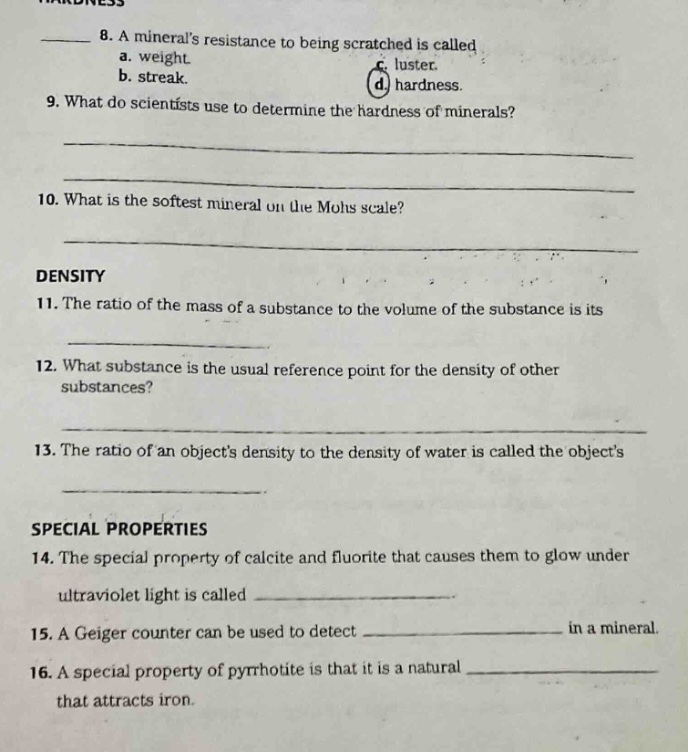
8. a minerals resistance to being scratched is called a. weight b. streak. c. luster. d. hardness. 9. what do scientists use to determine the hardness of minerals? 10. what is the softest mineral on the mohs scale? density 11. the ratio of the mass of a substance to the volume of the substance is its 12. what substance is the usual reference point for the density of other substances? 13. the ratio of an objects density to the density of water is called the objects special properties 14. the special property of calcite and fluorite that causes them to glow under ultraviolet light is called 15. a geiger counter can be used to detect in a mineral. 16. a special property of pyrrhotite is that it is a natural that attracts iron.
Answer
Brief Explanations:
- Scientists use the Mohs scale to determine the hardness of minerals. It is a qualitative ordinal scale from 1 - 10.
- Talc is the softest mineral on the Mohs scale, assigned a hardness of 1.
- The ratio of the mass of a substance to its volume is density.
- Water is the usual reference - point for the density of other substances. Its density is 1 g/cm³ at standard conditions.
- The ratio of an object's density to the density of water is called specific gravity.
- The special property of calcite and fluorite that causes them to glow under ultraviolet light is called fluorescence.
- A Geiger counter can be used to detect radioactivity in a mineral.
- A special property of pyrrhotite is that it is a natural magnet that attracts iron.
Answer:
- The Mohs scale
- Talc
- Density
- Water
- Specific gravity
- Fluorescence
- Radioactivity
- Magnet