much of the volcanic activity in iceland involves basalt flows. why is this expected? because basalt forms…
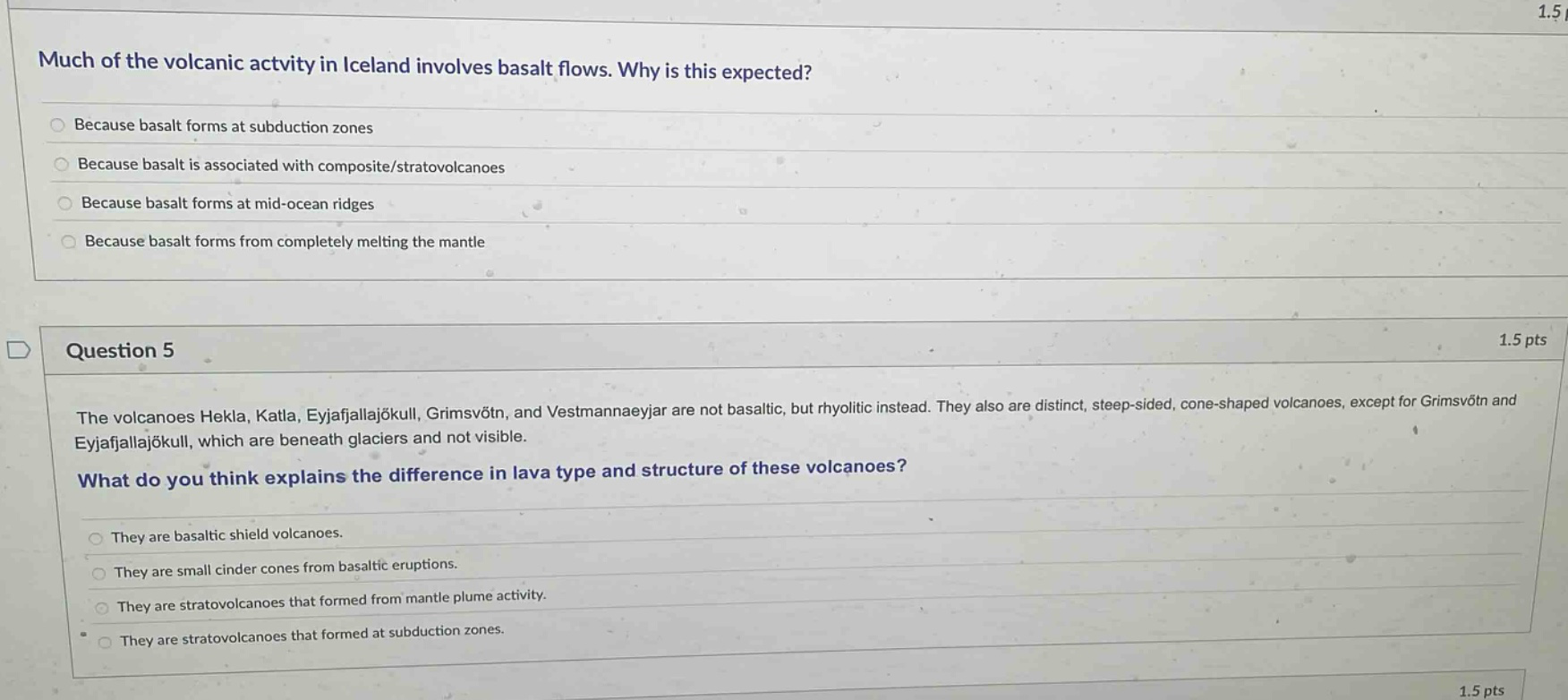
much of the volcanic activity in iceland involves basalt flows. why is this expected? because basalt forms at subduction zones because basalt is associated with composite/stratovolcanoes because basalt forms at mid - ocean ridges because basalt forms from completely melting the mantle question 5 the volcanoes hekla, katla, eyjafjallajökull, grimsvötn, and vestmannaeyjar are not basaltic, but rhyolitic instead. they also are distinct, steep - sided, cone - shaped volcanoes, except for grimsvötn and eyjafjallajökull, which are beneath glaciers and not visible. what do you think explains the difference in lava type and structure of these volcanoes? they are basaltic shield volcanoes. they are small cinder cones from basaltic eruptions. they are stratovolcanoes that formed from mantle plume activity. they are stratovolcanoes that formed at subduction zones.
Answer
Brief Explanations:
For the first question, Iceland is located on a mid - ocean ridge (the Mid - Atlantic Ridge). Basalt is commonly formed at mid - ocean ridges due to partial melting of the mantle. For the second question, steep - sided, cone - shaped volcanoes like Hekla and Katla are often stratovolcanoes which typically form at subduction zones where the composition of the magma is more silica - rich (rhyolitic) compared to basaltic magma at mid - ocean ridges.
Answer:
- Because basalt forms at mid - ocean ridges
- They are stratovolcanoes that formed at subduction zones.