a newborn giant panda has a mass of $9.0 \\times 10^{-2}$ kilograms. an adult male giant panda has a mass of…
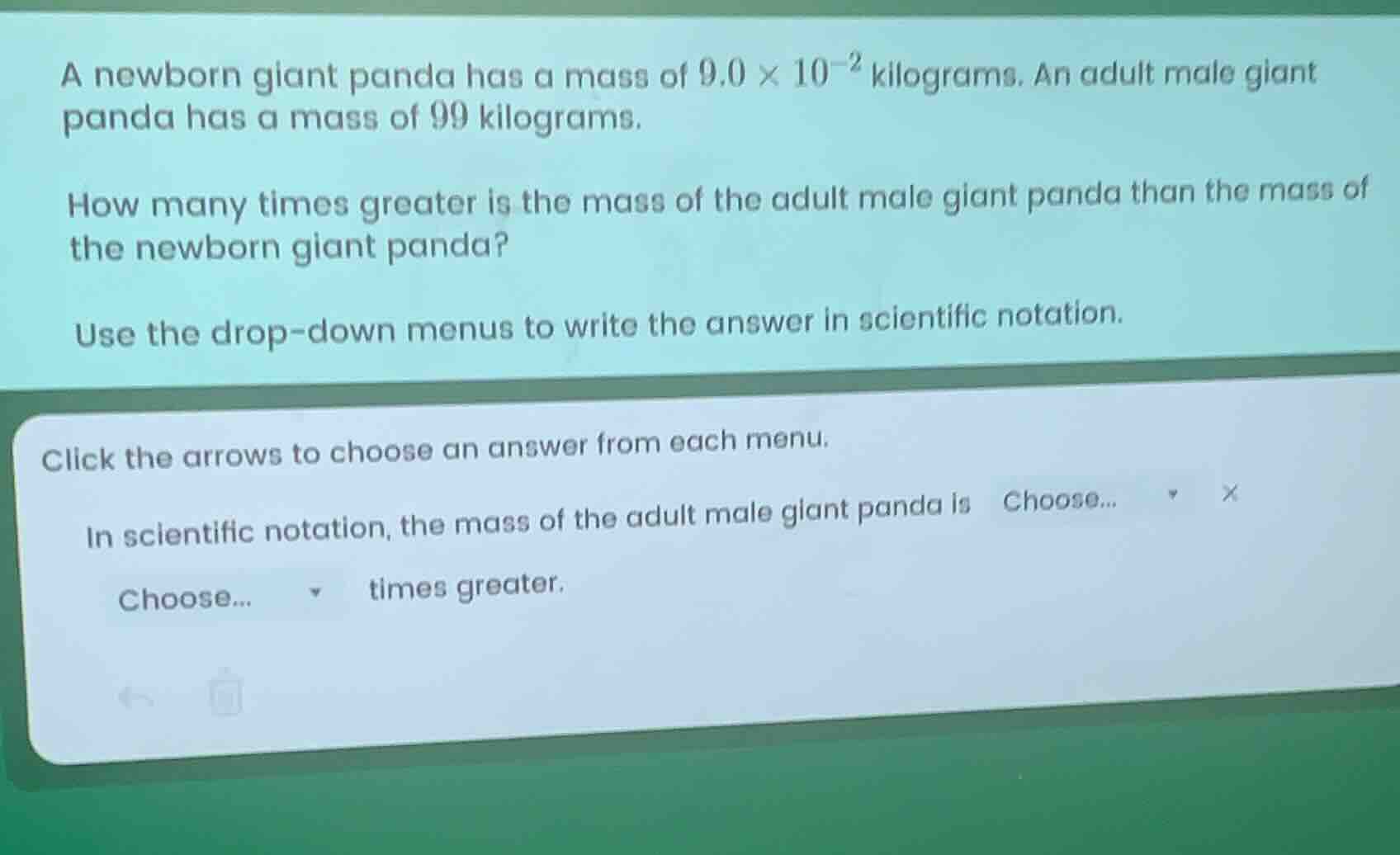
a newborn giant panda has a mass of $9.0 \\times 10^{-2}$ kilograms. an adult male giant panda has a mass of 99 kilograms.\nhow many times greater is the mass of the adult male giant panda than the mass of the newborn giant panda?\nuse the drop - down menus to write the answer in scientific notation.\nclick the arrows to choose an answer from each menu.\nin scientific notation, the mass of the adult male giant panda is choose... $\\times$ choose... times greater.
Answer
Explanation:
Step1: Convert 99 to scientific notation
To convert 99 to scientific notation, we can write it as (9.9\times10^{1}) (since (99 = 9.9\times10) and (10 = 10^{1})).
Step2: Divide the adult mass by the newborn mass
We know the newborn mass is (9.0\times10^{-2}) kg and the adult mass (in scientific notation) is (9.9\times10^{1}) kg. To find how many times greater the adult mass is, we divide the adult mass by the newborn mass: [ \frac{9.9\times10^{1}}{9.0\times10^{-2}}=\frac{9.9}{9.0}\times\frac{10^{1}}{10^{-2}} ] First, calculate (\frac{9.9}{9.0}=1.1). Then, using the rule of exponents (\frac{10^{a}}{10^{b}} = 10^{a - b}), we have (\frac{10^{1}}{10^{-2}}=10^{1-(-2)}=10^{3}). Multiply these two results together: (1.1\times10^{3}).
Answer:
In scientific notation, the mass of the adult male giant panda is (1.1) (\times) (10^{3}) times greater.