1. how does one use the mohs scale to determine a minerals hardness?\n2. what term refers to any mineral…
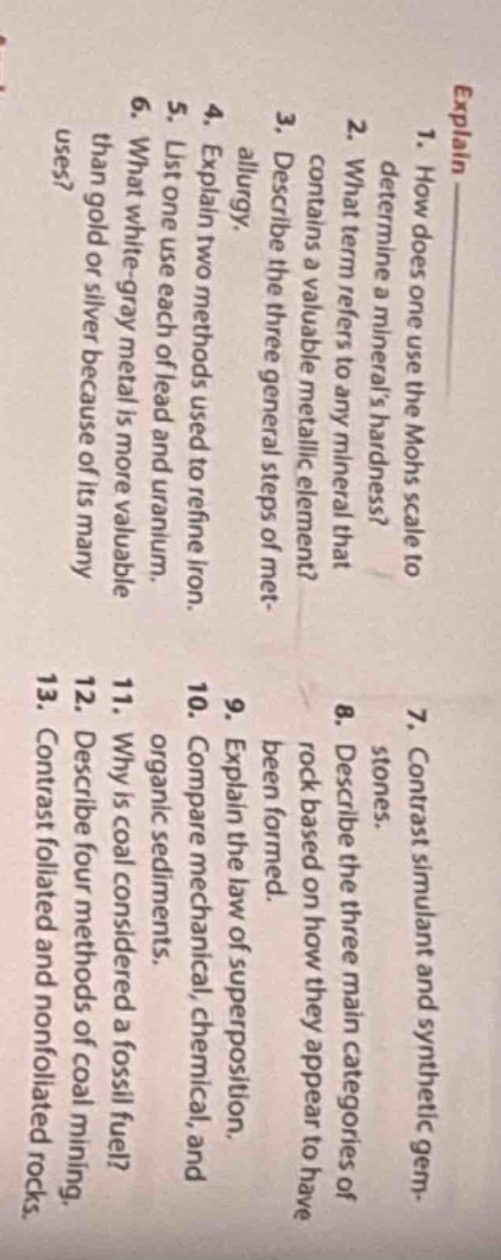
1. how does one use the mohs scale to determine a minerals hardness?\n2. what term refers to any mineral that contains a valuable metallic element?\n3. describe the three general steps of metallurgy.\n4. explain two methods used to refine iron.\n5. list one use each of lead and uranium.\n6. what white - gray metal is more valuable than gold or silver because of its many uses?\n7. contrast simulant and synthetic gem - stones.\n8. describe the three main categories of rock based on how they appear to have been formed.\n9. explain the law of superposition.\n10. compare the mechanical, chemical, and organic sediments.\n11. why is coal considered a fossil fuel?\n12. describe four methods of coal mining.\n13. contrast foliated and nonfoliated rocks.
Answer
Brief Explanations:
The Mohs scale is a relative hardness scale. One determines a mineral's hardness by seeing which minerals it can scratch and which can scratch it. For example, if a mineral can scratch calcite (Mohs hardness of 3) but is scratched by fluorite (Mohs hardness of 4), its hardness is between 3 and 4.
Answer:
One uses the Mohs scale by performing scratch - tests. Compare the mineral to known minerals on the scale to determine its relative hardness.
Brief Explanations:
A valuable metallic element is a metal that has economic value due to its properties like conductivity, malleability, and rarity. Examples include gold, silver, and platinum.
Answer:
A valuable metallic element is a metal with economic value and useful physical properties.
Brief Explanations:
The three general steps of metal - lurgy are mining (extracting the ore from the ground), refining (separating the metal from the ore and impurities), and alloying (combining the metal with other elements to improve its properties).
Answer:
Mining, refining, and alloying.
Brief Explanations:
Two methods used to refine iron are the blast furnace method and the basic oxygen furnace method. In the blast furnace, iron ore, coke, and limestone are heated to produce pig iron. The basic oxygen furnace uses pure oxygen to remove impurities from pig iron to produce steel.
Answer:
Blast furnace method and basic oxygen furnace method.
Brief Explanations:
Lead can be used in batteries due to its electrochemical properties. Uranium is used in nuclear power plants as a fuel for nuclear fission reactions.
Answer:
Lead is used in batteries. Uranium is used as a nuclear fuel.
Brief Explanations:
White - gray metal like platinum is more valuable than gold or silver in some cases because of its rarity, high melting point, and catalytic properties in industrial processes.
Answer:
White - gray metals like platinum are more valuable due to rarity and useful properties.
Brief Explanations:
Simulant gems are natural - looking substitutes for real gems, often made of glass or other inexpensive materials. Synthetic gems are produced in a laboratory with the same chemical and physical properties as natural gems.
Answer:
Simulant gems are substitutes; synthetic gems have same properties as natural ones but are lab - made.
Brief Explanations:
The three main categories of rocks based on appearance are igneous (formed from cooling and solidification of magma or lava), sedimentary (formed from accumulation and compaction of sediments), and metamorphic (formed from transformation of existing rocks due to heat, pressure, and chemical changes).
Answer:
Igneous, sedimentary, and metamorphic rocks.
Brief Explanations:
The law of superposition states that in undisturbed sedimentary rock layers, the oldest layers are at the bottom and the youngest are at the top.
Answer:
In undisturbed sedimentary rocks, older layers are at the bottom and younger ones at the top.
Brief Explanations:
Mechanical sediments are formed by the physical breakdown of rocks, like through weathering and erosion. Chemical sediments form when minerals precipitate out of a solution, such as in the formation of salt deposits from evaporating seawater. Organic sediments are formed from the accumulation of plant and animal remains, like in the formation of coal.
Answer:
Mechanical sediments from rock breakdown, chemical from mineral precipitation, organic from plant/animal remains.
Brief Explanations:
Coal is considered a fossil fuel because it is formed from the remains of plants that lived millions of years ago. These plant remains were buried and subjected to heat and pressure over time, transforming them into coal.
Answer:
Coal is formed from ancient plant remains, making it a fossil fuel.
Brief Explanations:
Four methods of coal mining are surface mining (strip mining, open - pit mining), underground mining (room - and - pillar mining, longwall mining). Surface mining is used when coal is close to the surface, and underground mining is for deeper coal deposits.
Answer:
Strip mining, open - pit mining, room - and - pillar mining, longwall mining.
Brief Explanations:
Foliated rocks have a layered or banded appearance due to the alignment of minerals during metamorphism. Non - foliated rocks lack this layered structure and have a more uniform texture, like marble or quartzite.
Answer:
Foliated rocks are layered; non - foliated rocks have a uniform texture.