2. an online store uses 6 - bit binary sequences to identify each unique item for sale. the store plans to…
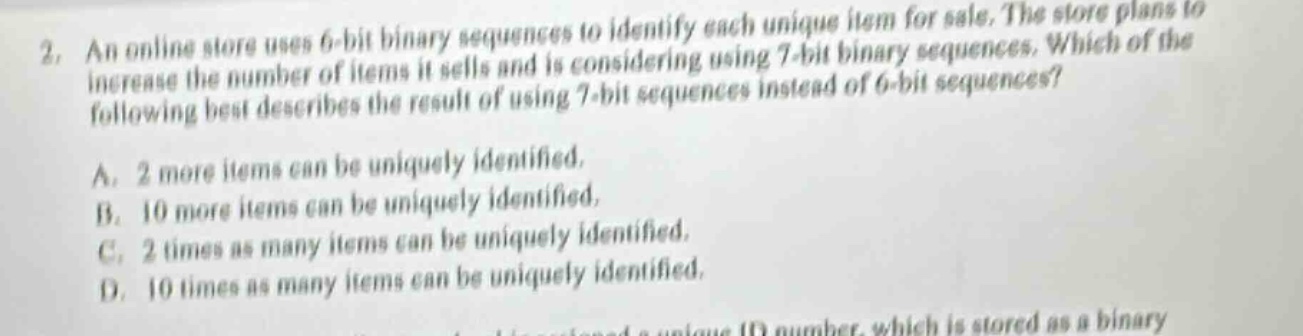
2. an online store uses 6 - bit binary sequences to identify each unique item for sale. the store plans to increase the number of items it sells and is considering using 7 - bit binary sequences. which of the following best describes the result of using 7 - bit sequences instead of 6 - bit sequences?\na. 2 more items can be uniquely identified.\nb. 10 more items can be uniquely identified.\nc. 2 times as many items can be uniquely identified.\nd. 10 times as many items can be uniquely identified.
Answer
Explanation:
Step1: Calculate number of 6 - bit sequences
The number of unique values that can be represented by an $n$-bit binary sequence is $2^n$. For a 6 - bit sequence, the number of unique items it can identify is $2^6=64$.
Step2: Calculate number of 7 - bit sequences
For a 7 - bit sequence, the number of unique items it can identify is $2^7 = 128$.
Step3: Find the ratio
To find out how the number of identifiable items changes, we calculate the ratio $\frac{2^7}{2^6}$. Using the rule of exponents $\frac{a^m}{a^n}=a^{m - n}$, we have $\frac{2^7}{2^6}=2^{7 - 6}=2$.
Answer:
C. 2 times as many items can be uniquely identified.