b. open compass traverse\n2. an open compass traverse was conducted with the following bearings. plot the…
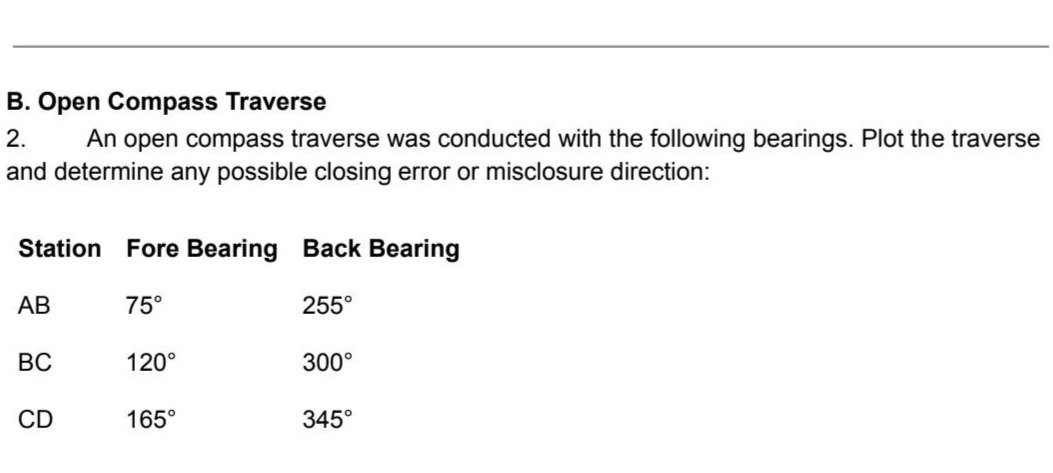
b. open compass traverse\n2. an open compass traverse was conducted with the following bearings. plot the traverse and determine any possible closing error or misclosure direction:\nstation fore bearing back bearing\nab 75° 255°\nbc 120° 300°\ncd 165° 345°
Answer
Explanation:
Step1: Recall traverse - closing error concept
In a traverse, for a closed - loop traverse, the sum of interior angles should satisfy a certain geometric condition. For an open traverse, we can analyze the angular relationships. The difference between the back - bearing and the fore - bearing of a line should be 180°.
Step2: Check angular relationships for each line
For line AB: Back - bearing ($255^{\circ}$) - Fore - bearing ($75^{\circ}$)=$255 - 75=180^{\circ}$. For line BC: Back - bearing ($300^{\circ}$) - Fore - bearing ($120^{\circ}$)=$300 - 120 = 180^{\circ}$. For line CD: Back - bearing ($345^{\circ}$) - Fore - bearing ($165^{\circ}$)=$345 - 165=180^{\circ}$. Since the difference between the back - bearing and the fore - bearing of each line is 180°, there is no angular misclosure in terms of these individual line - bearing relationships. When plotting the traverse, we start from a reference point, draw lines at the given fore - bearings from each station. Since there is no angular misclosure in the given data, there is no obvious closing error or misclosure direction indicated by the bearing data alone.
Answer:
There is no obvious closing error or misclosure direction indicated by the given bearing data.