2. which is the order, from first to last, of the formation of a fossil? f. r,t,q,s g. q,r,s,t h. q,s,t,r j…
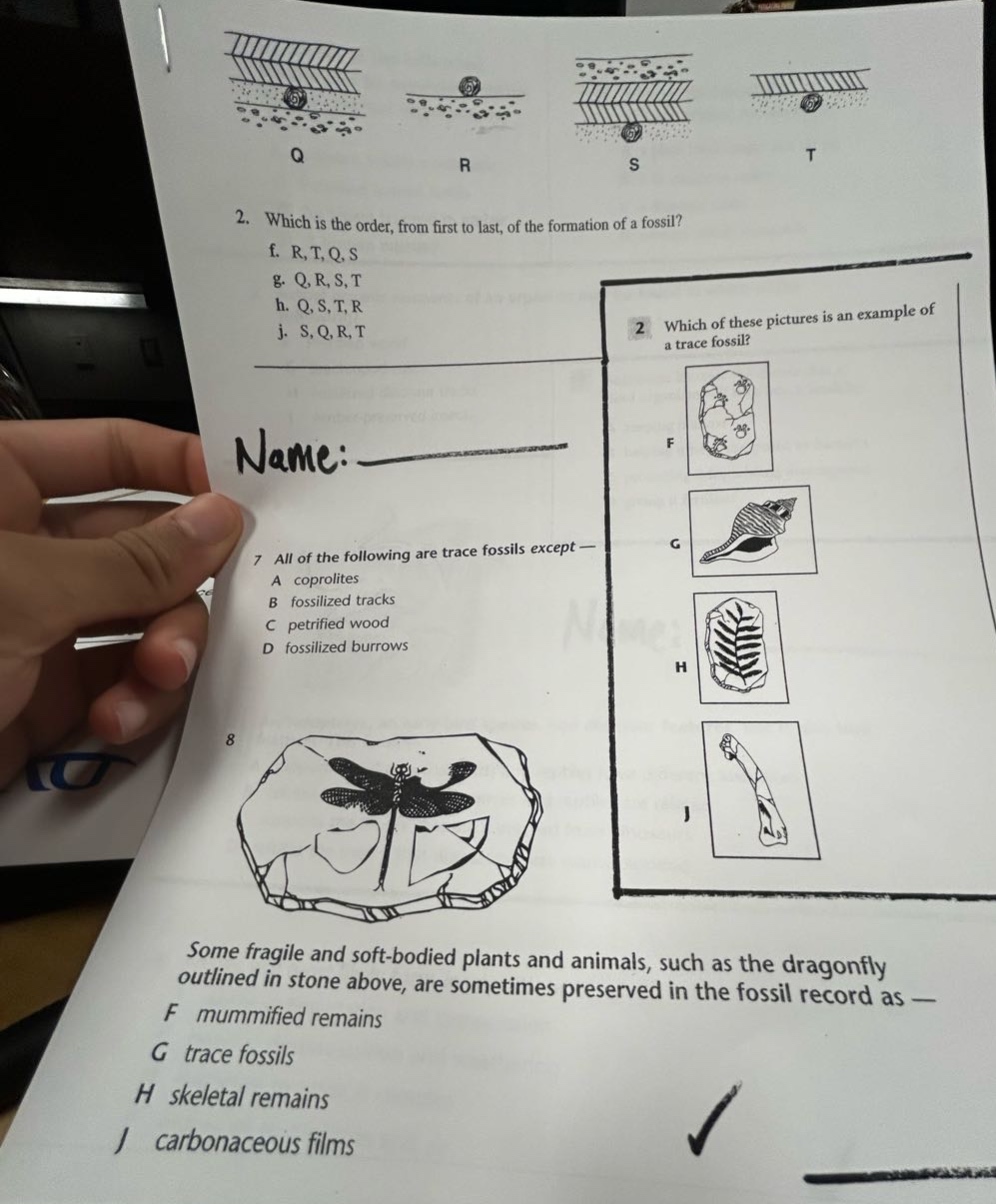
2. which is the order, from first to last, of the formation of a fossil? f. r,t,q,s g. q,r,s,t h. q,s,t,r j. s,q,r,t name: 7 all of the following are trace fossils except — a coprolites b fossilized tracks c petrified wood d fossilized burrows 8 some fragile and soft - bodied plants and animals, such as the dragonfly outlined in stone above, are sometimes preserved in the fossil record as — f mummified remains g trace fossils h skeletal remains j carbonaceous films 2 which of these pictures is an example of a trace fossil? f g h j
Answer
Brief Explanations:
- For the order of fossil - formation: First, an organism dies (R). Then it is buried (T). Over time, sediment accumulates (Q), and compaction and cementation occur (S).
- A trace fossil is evidence of an organism's activity. Fossilized tracks, coprolites (fossilized feces), and fossilized burrows are trace fossils. Petrified wood is a fossil formed by permineralization, not a trace fossil.
- Fragile and soft - bodied organisms like the dragonfly can be preserved as carbonaceous films when the organic material is compressed and leaves a thin carbon - rich layer.
Answer:
- f. R, T, Q, S
- C. petrified wood
- J. carbonaceous films