2 ordering 2 points put the layers (by letter) in order from oldest to youngest. oldest 1 c 2 e 3 b 4 d 5 a…
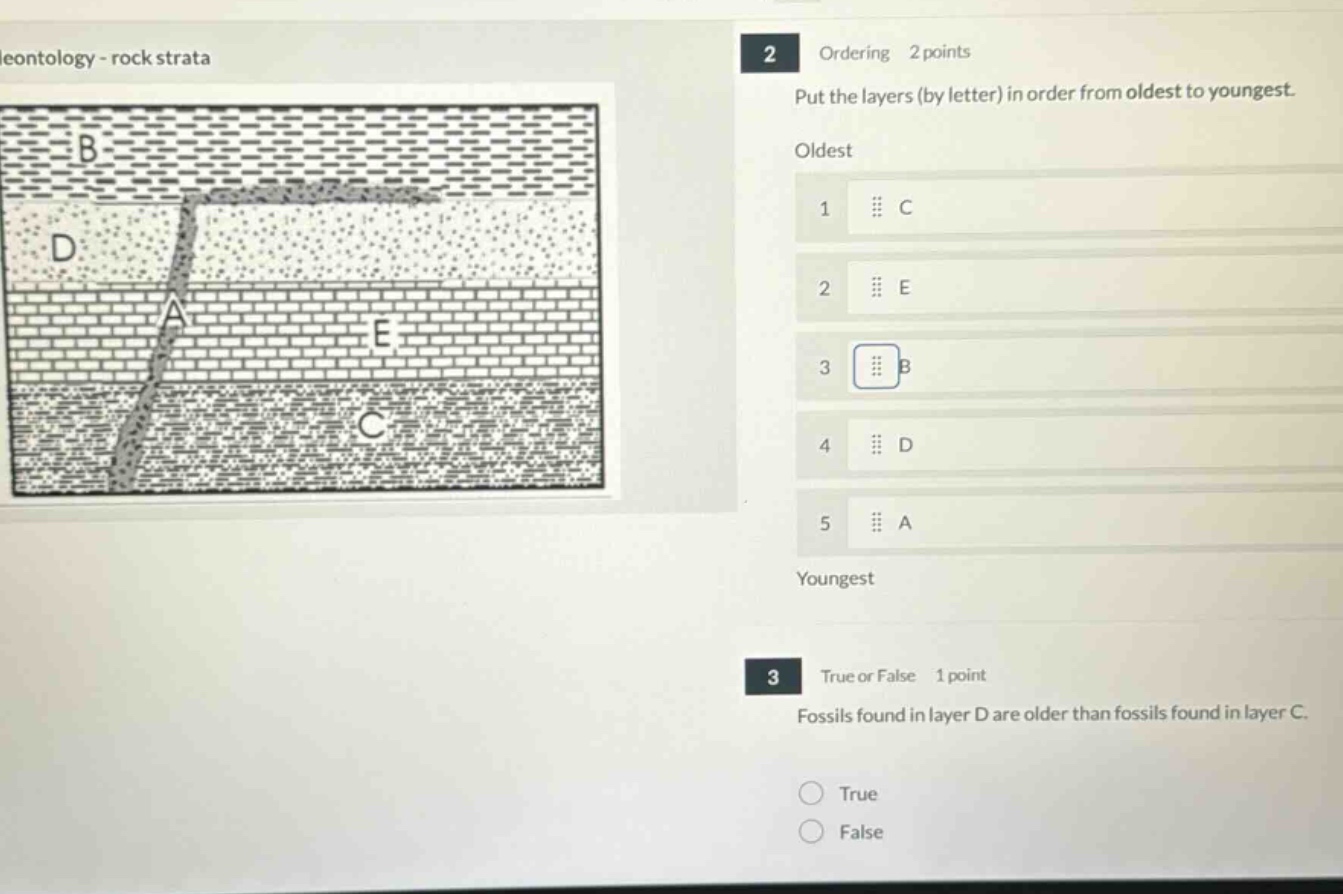
2 ordering 2 points put the layers (by letter) in order from oldest to youngest. oldest 1 c 2 e 3 b 4 d 5 a youngest 3 true or false 1 point fossils found in layer d are older than fossils found in layer c. true false
Answer
Explanation:
Step1: Apply law of superposition
In undisturbed rock - strata, the oldest layer is at the bottom and the youngest is at the top. Layer C is at the bottom, so it is the oldest.
Step2: Identify next - oldest layer
Layer E is above C but below other layers, so it is the second - oldest.
Step3: Determine third - oldest layer
Layer B is above E, making it the third - oldest.
Step4: Find fourth - oldest layer
Layer D is above B, so it is the fourth - oldest.
Step5: Identify youngest layer
Layer A is a fault or intrusion that cuts through other layers, so it is the youngest. For question 3, since C is below D, fossils in C are older. So the statement "Fossils found in layer D are older than fossils found in layer C" is false.
Answer:
- Oldest: 1. C, 2. E, 3. B, 4. D, 5. A
- False