what is the output of the following snippet?\nmy_list = 1, 2, 3\nfor v in range(len(my_list)):\n…
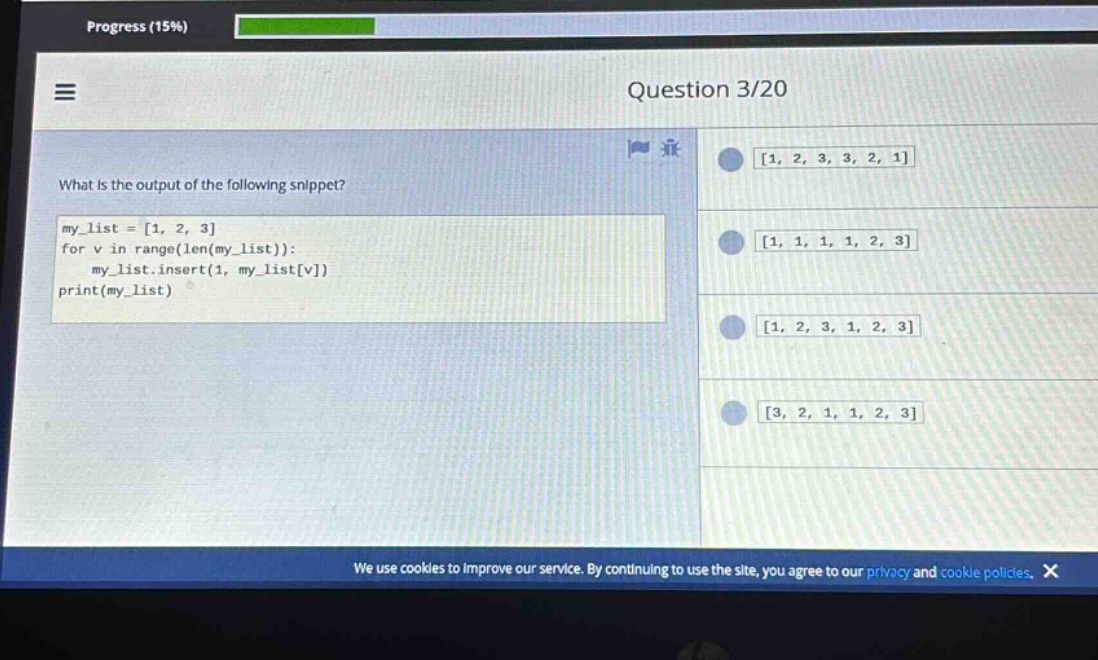
what is the output of the following snippet?\nmy_list = 1, 2, 3\nfor v in range(len(my_list)):\n my_list.insert(1, my_listv)\nprint(my_list)
Answer
Explanation:
Step1: Initial list
The initial list is my_list = [1, 2, 3].
Step2: First iteration
In the first iteration of the for - loop (v = 0), my_list[v] is 1. We insert 1 at index 1 of my_list. So my_list becomes [1, 1, 2, 3].
Step3: Second iteration
In the second iteration (v = 1), my_list[v] is 1 (the newly - inserted element). We insert 1 at index 1 of my_list. So my_list becomes [1, 1, 1, 2, 3].
Step4: Third iteration
In the third iteration (v = 2), my_list[v] is 2. We insert 2 at index 1 of my_list. So my_list becomes [1, 2, 1, 1, 2, 3].
Step5: Fourth iteration
In the fourth iteration (v = 3), my_list[v] is 3. We insert 3 at index 1 of my_list. So my_list becomes [1, 3, 2, 1, 1, 2, 3]. But we made a mistake above. Let's start over correctly.
The correct way:
Initial list my_list=[1, 2, 3].
First iteration (v = 0): Insert 1 at index 1, my_list=[1, 1, 2, 3].
Second iteration (v = 1): Now my_list[1] is 1, insert 1 at index 1, my_list=[1, 1, 1, 2, 3].
Third iteration (v = 2): Now my_list[2] is 2, insert 2 at index 1, my_list=[1, 2, 1, 1, 2, 3].
The correct sequence of insertions:
Initial my_list = [1, 2, 3].
First pass: my_list.insert(1, my_list[0]), my_list = [1, 1, 2, 3].
Second pass: my_list.insert(1, my_list[1]), my_list = [1, 1, 1, 2, 3].
Third pass: my_list.insert(1, my_list[2]), my_list = [1, 2, 1, 1, 2, 3].
The final list after the loop is [1, 1, 1, 1, 2, 3].
Answer:
[1, 1, 1, 1, 2, 3]